Composite Insulator Supplier Evaluation: Verifying Capability and Securing Delivery
Composite insulator supplier evaluation is a document-matching exercise before it is a commercial one. A supplier's real capability is established less by how a catalog describes the company than by whether the certificate number, the type test report, and the item-level datasheet it provides can be matched, value by value, to the insulators and fittings on your purchase order.
This guide is written for procurement teams, EPC buyers, utility sourcing engineers, and importers who have already shortlisted suppliers and are now moving from evaluation into execution. It sets out a four-layer evidence model, a seven-stage verification process that can be run against any composite insulator supplier, and worked examples of documentation that make delivery assurance checkable instead of assumed.
China Energy and Chemical Industry Co.,Ltd (CECI) is a Zhengzhou, Henan-based manufacturer and exporter of polymer composite insulators, porcelain and glass insulators, metal fittings for insulators, and overhead line hardware fittings and accessories. Founded in 2017, the company operates a 30,000 m² facility with approximately 100 employees and an eight-engineer R&D team, reports an annual output of 8,000,000 units, and exports roughly 95% of its production to markets including Russia, Vietnam, France, Spain, Italy, Türkiye, Brazil, Poland, Indonesia, and Saudi Arabia. Its certificates, test reports, and product parameters are used below as concrete examples; the same verification checks apply to every supplier on your shortlist.
The Verification Gap: Where Composite Insulator Supplier Evaluation Usually Fails
Most sourcing failures in this category do not come from choosing a completely unknown supplier. They come from evaluating a supplier at category level and receiving goods at item level. Three gaps account for a large share of the mismatch.
Gap 1: The certificate covers a scope narrower than the quotation
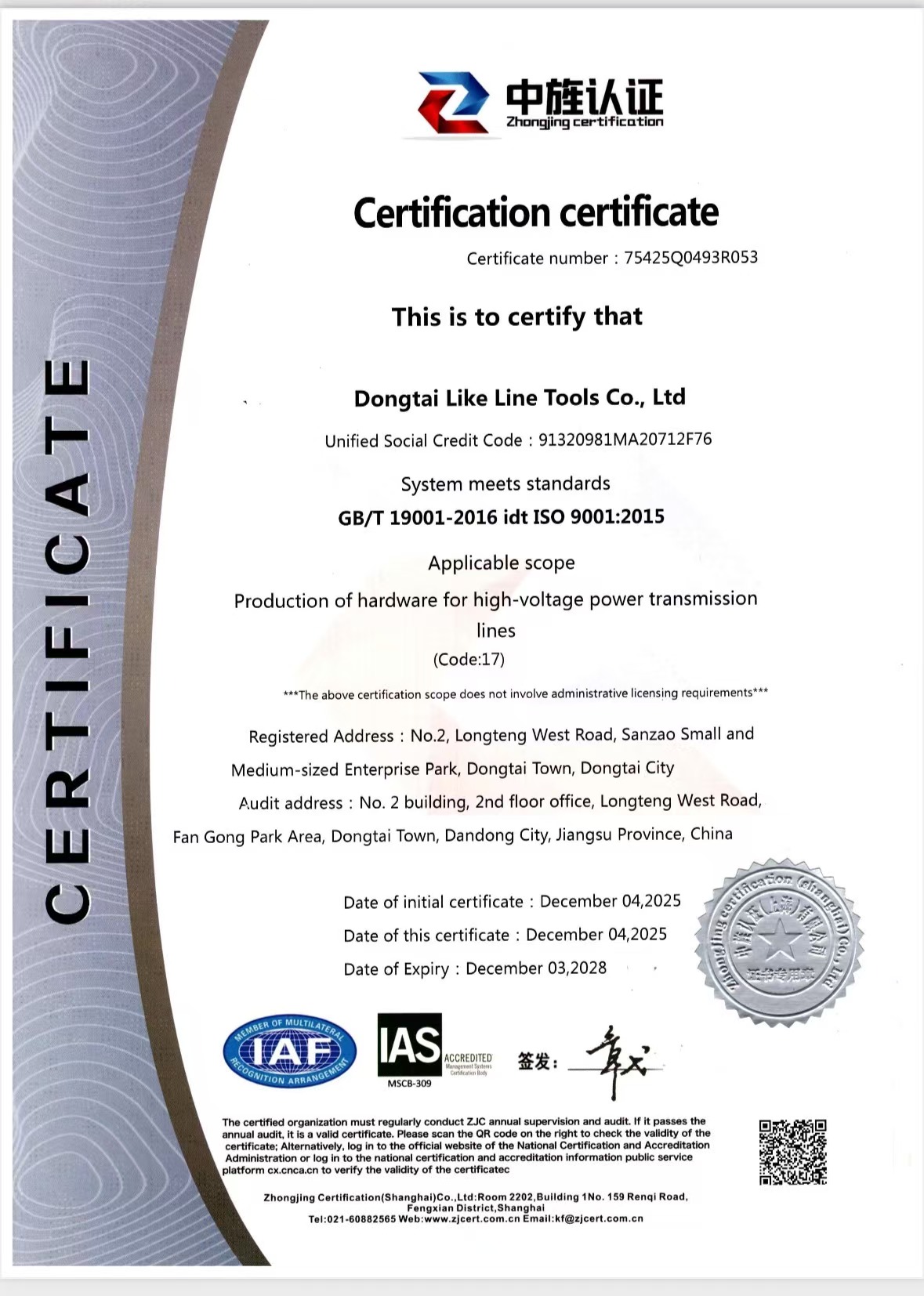
A quality management certificate is defined by its scope statement, and that statement is often narrower than the product list printed on a sales quotation. CECI's records show the pattern clearly. Certificate 75425Q0493R053, issued by Zhongjing Certification (Shanghai) Co.,Ltd., covers the production of hardware for high-voltage power transmission lines and is valid from 4 December 2025 to 3 December 2028. Certificate 75424Q0348R0S, issued by the same certification body, covers the manufacturing of power fittings, specifically high-voltage line fittings and accessories, and is valid from 22 July 2024 to 21 July 2027. Both certificates are issued against GB/T 19001-2016 idt ISO 9001:2015, and both are directly relevant to the fittings side of an insulator order. A buyer who records only the words ISO 9001 certified learns nothing about coverage; a buyer who reads the scope statement knows exactly which part of the order the certificate supports and where additional product-level evidence is still required.
Gap 2: The datasheet describes a family, not a model
Insulator datasheets frequently list a product family with a voltage range and a load range, while the purchase order specifies one model with one set of mechanical, electrical, and dimensional values. Unless the supplier's document names the exact model, the buyer is accepting a family-level claim for an item-level commitment — and the discrepancy only becomes visible during incoming inspection.
Gap 3: Mechanical interfaces are assumed rather than documented
Insulator bodies and their fittings are separate items with separate documentation. Where the insulator's connection structure code and the accessory's designated coupling size are both recorded, the interface can be verified on paper before shipment. Where one of the two is missing, compatibility is assumed, and the problem surfaces at assembly rather than at drawing review.
Published market data diverges too. Estimates for the 2024 global composite insulator market include USD 6.58 billion (Market Research Future) and, from other research firms, USD 3.42 billion (Strategic Market Research) and USD 2.35 billion (Reports and Data). Divergence among third-party sources is normal in this category. The practical conclusion for a procurement team is not to distrust all numbers, but to attribute every figure used in an internal evaluation memo — including figures supplied by the vendor being evaluated.
Industry Background: A Market Where Verification Outweighs Presentation
Composite insulators are a substantial and still-expanding procurement category. The global composite insulators market was valued at approximately USD 6.58 billion in 2024 and is projected to reach USD 9.3 billion by 2035, according to Market Research Future. Asia-Pacific accounted for roughly 49.5% of 2024 revenue, based on Mordor Intelligence's market analysis, and one industry analysis estimates China at about 45% of global manufacturing output — an estimate that is directional rather than audited.
Product mix matters to sourcing strategy. Suspension insulators were estimated to hold around 38% of the market in 2025 (Future Market Insights), and the 11 kV to 200 kV rating segment accounted for approximately 33% of total market share in the same year (Future Market Insights). For most utility, EPC, and distribution buyers, that mid-voltage band — 35 kV line post and station post units, 66 kV line post insulators, 132 kV dead end tension strings — is where day-to-day procurement volume sits.
The standards environment is also active. IEC 61109:2025 covers composite suspension and tension insulators for AC and DC systems with nominal voltages above 1,000 V, and ANSI/NEMA C29.11-2020 defines test methods and performance characteristics for composite insulators used in North American overhead transmission lines. A credible supplier should be able to state, in writing, which standard set its product-level test evidence was produced against — and should be able to produce the report itself, not only the standard number.
Competition in the category is mixed. Published market analyses list global competitors including Hitachi Energy, NGK Insulators Ltd., Seves Group (Sediver), Siemens Energy, and Hubbell Power Systems, alongside a large base of regional manufacturers serving project-level demand. For a procurement team, this structure means the realistic choice is rarely between globally branded suppliers and nobody else; it is between suppliers whose documentation can be verified and suppliers whose capability can only be inferred from presentation. Applications with tighter constraints — coastal salt spray exposure, heavy contamination areas, high-altitude lines, anti-pollution station post installations, and UV-exposed outdoor service — raise the cost of a verification miss.
The Four-Layer Evidence Model for Verifying a Composite Insulator Supplier
Treat supplier capability as four layers of evidence rather than a single approval decision. Each layer answers a different question, and each one can be checked independently.
Layer 1: Quality system evidence — can the supplier's management system be checked?
This layer is the certificate itself, read in full: certificate number, issuing body, scope statement, standard, and validity window. For CECI, the two certificates referenced above are issued by Zhongjing Certification (Shanghai) Co.,Ltd. against GB/T 19001-2016 idt ISO 9001:2015, with declared market coverage of Europe and the Americas, the Middle East, and Central Asia. The value of this layer is traceability: a certificate number can be verified with the issuing body, while a certification logo cannot.
Layer 2: Product-level test evidence — has the specific product type been tested to a named standard?
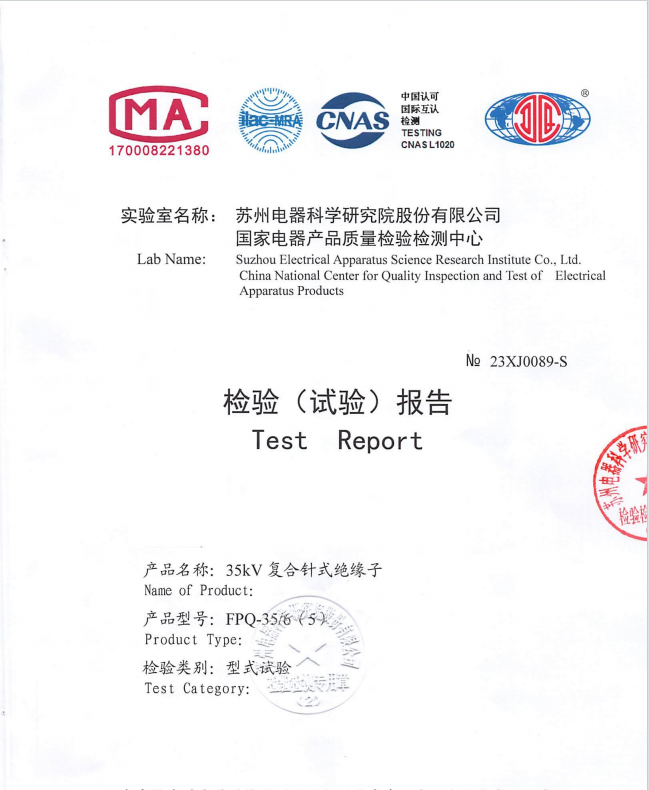
Type test evidence sits closer to the order than a management system certificate. CECI's records include test report 23XJ0089-S, issued on 13 July 2023 by Suzhou Electrical Apparatus Science Research Institute Co., Ltd. and the China National Center for Quality Inspection and Test of Electrical Apparatus Products, covering a 35 kV composite pin insulator, model FPQ-35/6 (5), with tests carried out according to IEC 61109 and with IEC 60815, IEC 61109, IEC 62217, and IEC 61466 cited in the standard set. The report's declared market coverage spans Europe, the Middle East, Southeast Asia, and the Americas. The evaluation lesson is straightforward: a report is only useful when its stated scope names the model you are buying. If it does not, request the report that does, or carry the gap as an open risk item.
Layer 3: Item-level specification data — do the numbers match the order line?
This is where most buying decisions are actually made. Item-level data means mechanical load, electrical withstand values, creepage distance, arcing distance, structural height, material, and interface designation, stated for one model number.
The polymer example is the silicone rubber suspension long rod FXB-24-70-785mm, specified with a 35 kV rated voltage, a lightning impulse withstand voltage above 230 kV, a power frequency one-minute wet withstand voltage above 95 kV, a minimum creepage distance above 1,050 mm, and a rated bending load of 5 kN, with a material set of silicone, fiber glass, and carbon steel / C45. The porcelain example is model U70BP/146D, with a nominal structural height of 146 mm, a creepage distance of 255 mm, a minimum arcing distance of 450 mm, a rated electromechanical failing load of 70 kN, and a connection structure code of 16. The glass example is the 70B post line insulator, brown, with a creepage distance of 255 mm, a nominal disc diameter of 255 mm, a nominal structural height of 146 mm, a minimum arcing distance of 450 mm, a power frequency puncture voltage of 135 kV, a dry withstand voltage of 65 kV, a wet withstand voltage of 45 kV, a cantilever load of 10 kN, a rated electromechanical failing load of 70 kN, and a connection structure code of 16.
Each of these values can be checked against a drawing, a packing list, or a first-article inspection. None of them can be checked against the phrase high quality.
Layer 4: Capacity, lead time, and support evidence — can the supplier deliver on schedule?
Delivery assurance rests on numbers the supplier commits to in writing. CECI publishes a monthly capacity of 500 tons or 100,000 pieces, a production lead time of 30 to 45 days, a minimum order quantity of 500 units, a quality control method described as 100% test, and after-sales support delivered remotely. The company also offers OEM and ODM production, with customization available across voltage, creepage distance, lightning impulse withstand voltage, bending load, color, and logo. Taken together, these are the parameters that let a buyer build a schedule and a budget instead of relying on assurances.
Step-by-Step: A Seven-Stage Supplier Verification Process
Step 1: Request the certificate file, not the certification claim
Ask for the certificate file and copy five fields into your evaluation sheet: certificate number, issuing certification body, scope statement, standard reference, and validity dates. For CECI, those fields resolve to certificate 75425Q0493R053, valid from 4 December 2025 to 3 December 2028, and certificate 75424Q0348R0S, valid from 22 July 2024 to 21 July 2027, both issued by Zhongjing Certification (Shanghai) Co.,Ltd. against GB/T 19001-2016 idt ISO 9001:2015.
Step 2: Map the certificate scope onto your purchase order lines
Draw a line between each order item and the certificate scope that covers it. High-voltage line fittings and accessories are covered by the scopes above. For insulator bodies, ask which product-level document supports the ordered model, because a management system certificate is not a product approval.
Step 3: Ask for the type test report and read the scope line first
Report number, testing institute, issue date, standard set, and covered model come before any performance value. Test report 23XJ0089-S names a 35 kV composite pin insulator, model FPQ-35/6 (5), tested according to IEC 61109 and referencing IEC 60815, IEC 61109, IEC 62217, and IEC 61466, issued by Suzhou Electrical Apparatus Science Research Institute Co., Ltd. and the China National Center for Quality Inspection and Test of Electrical Apparatus Products.
Step 4: Verify electrical, mechanical, and dimensional parameters per model
Build a comparison line for each ordered model: rated voltage, impulse withstand, wet withstand, creepage distance, arcing distance, structural height, failing load, bending or cantilever load, and interface code. Use the values quoted in Layer 3 as a format example, and require the supplier to state values for the exact model numbers you intend to purchase — not for a product family.
Step 5: Verify fittings and accessories as separate line items
Accessories carry their own specification and their own risk. The Ball-Head Suspension Ring QP-7 is specified as a hot-dip galvanized steel accessory for the electricity industry, used in overhead power transmission lines, with a ball-head design, a designated coupling size of 16, a rated failing load of 70 kN, and a net weight of 0.3 kg. Because U70BP/146D and the 70B glass insulator both record a connection structure code of 16, the coupling designation can be cross-checked against the accessory specification before the order is placed. That single cross-check removes an entire class of assembly-stage problems.
Step 6: Match capacity, MOQ, and lead time to your project schedule
Convert the supplier's stated capacity into your own units: 500 tons or 100,000 pieces per month, a 30 to 45 day lead time, and a 500-unit minimum order quantity are the figures CECI commits to. Then compare them with your installation sequence rather than with a generic delivery expectation. Where a project mixes several models, confirm the lead time model by model.
Step 7: Lock inspection and documentation into the order
Specify the inspection method — CECI's stated quality control is 100% test — the documents that must travel with each shipment (certificate copies, the applicable test report, item datasheets, and the packing list), and the after-sales route (remote support). Delivery assurance is created at the order-writing stage; it is only confirmed at the receiving stage.
Use Cases: What Verified Capability Looks Like in Deployment
The clearest test of any supplier evaluation method is whether the supplier's own delivery record can be described with the same precision as its certificates.
CECI's records describe a program of 10,000 units delivered to customers in Brazil, Italy, Turkey, and Vietnam over a three-year duration. The customer types were utility companies, power EPC contractors, railway operators and contractors, distributors, and resellers. The application scope covered mechanical support and insulation on transmission lines, substation insulation, railway catenary or ground equipment insulation, and fuse and overvoltage protection. The reported outcome of using polymer and glass insulators in that context was enhanced line stability, reduced maintenance intensity, and improved pollution resistance, with lightweight designs, anti-pollution flashover and aging resistance, customizable end fittings, and FRP rod core supply identified as the product characteristics that supported those results.
Two aspects of that account are worth copying into your own supplier scorecards. First, it names customer types and countries rather than an anonymous global customer base — verifiable references are more useful than aggregate claims. Second, it names the insulation functions performed (line support, substation insulation, railway catenary, overvoltage protection) rather than product categories alone. When you evaluate candidates for coastal salt spray projects, heavy contamination areas, or high-altitude lines, ask for the same level of specificity: which function, which environment, which model, and which documentation set.
Comparison Tables: Documented Product Data and Evidence Checks
The first table assembles item-level parameters documented for three CECI insulator types. Treat it as a format example: substitute your own ordered models and require the same values to be stated on the supplier datasheet.
| Parameter | Polymer suspension long rod FXB-24-70-785mm | Porcelain insulator U70BP/146D | Glass post line insulator 70B |
|---|---|---|---|
| Category / type | Suspension long rod (polymer insulator) | Porcelain insulator | Glass insulator, post line |
| Material | Silicone, fiber glass, carbon steel / C45 | Not stated in the referenced record | Not stated in the referenced record |
| Rated voltage | 35 kV | Not stated in the referenced record | Not stated in the referenced record |
| Lightning impulse withstand voltage | Above 230 kV | Not stated in the referenced record | Not stated in the referenced record |
| Power frequency 1-minute wet withstand voltage | Above 95 kV | Not stated in the referenced record | 45 kV |
| Dry withstand voltage | Not stated in the referenced record | Not stated in the referenced record | 65 kV |
| Power frequency puncture voltage | Not stated in the referenced record | Not stated in the referenced record | 135 kV |
| Creepage distance | Minimum above 1,050 mm | 255 mm | 255 mm |
| Minimum arcing distance | Not stated in the referenced record | 450 mm | 450 mm |
| Nominal structural height | Not stated in the referenced record | 146 mm | 146 mm |
| Nominal disc diameter | Not stated in the referenced record | Not stated in the referenced record | 255 mm |
| Rated bending load / cantilever load | 5 kN rated bending load | Not stated in the referenced record | 10 kN cantilever load |
| Rated electromechanical failing load | Not stated in the referenced record | 70 kN | 70 kN |
| Connection structure code | Not stated in the referenced record | 16 | 16 |
| Color | Not stated in the referenced record | Not stated in the referenced record | Brown |
The second table converts the four evidence layers into an evaluation checklist. The risk column states what is missing when the evidence item is absent.
| Evidence layer | What to request | Documented example (CECI records) | Risk if missing |
|---|---|---|---|
| Quality system | ISO 9001 certificate file with number, issuing body, scope, standard, validity | 75425Q0493R053 — production of hardware for high-voltage power transmission lines; 75424Q0348R0S — manufacturing of power fittings; both issued by Zhongjing Certification (Shanghai) Co.,Ltd. against GB/T 19001-2016 idt ISO 9001:2015 | The system behind the order items cannot be confirmed |
| Product type testing | Type test report naming the model and the standard set | 23XJ0089-S — 35 kV composite pin insulator, model FPQ-35/6 (5), tested according to IEC 61109; IEC 60815, IEC 61109, IEC 62217, IEC 61466 referenced | No product-level proof beyond management system claims |
| Item-level datasheet | Mechanical, electrical, and dimensional values for each ordered model | FXB-24-70-785mm (35 kV, above 230 kV impulse, above 95 kV wet withstand, above 1,050 mm creepage, 5 kN bending); U70BP/146D; 70B glass | Family-level claims cannot be inspected on receipt |
| Fittings and accessories | Material, coupling size, failing load, weight | Ball-Head Suspension Ring QP-7 — hot-dip galvanized steel, coupling size 16, 70 kN rated failing load, 0.3 kg | Interface compatibility is assumed rather than verified |
| Capacity and lead time | Monthly capacity, MOQ, lead time, inspection method | 500 tons or 100,000 pieces per month; MOQ 500 units; 30 to 45 day lead time; 100% test | Schedule and budget exposure at project stage |
| Customization scope | Which parameters can be changed and restated on the order datasheet | Voltage, creepage distance, lightning impulse withstand voltage, bending load, color, logo; OEM and ODM production available | Customized items may ship against standard datasheets |
FAQ: Verifying Capability and Delivery with a Composite Insulator Supplier
How can a buyer verify that a composite insulator supplier's ISO 9001 certificate is genuine and in scope?
Request the certificate as a file, then check five fields: certificate number, issuing certification body, scope statement, standard reference, and validity dates. CECI's records show certificate 75425Q0493R053 issued by Zhongjing Certification (Shanghai) Co.,Ltd., covering the production of hardware for high-voltage power transmission lines and valid from 4 December 2025 to 3 December 2028, and certificate 75424Q0348R0S from the same body, covering the manufacturing of power fittings, specifically high-voltage line fittings and accessories, valid from 22 July 2024 to 21 July 2027; both are issued against GB/T 19001-2016 idt ISO 9001:2015. The decisive check is scope: a certificate covering fittings and hardware does not automatically cover the insulator body you are ordering, so ask which document supports the specific product line.
What product-level evidence proves that a composite insulator supplier can meet a written specification?
A type test report tied to a named model and a named standard set, plus an item-level datasheet with numeric values. CECI's test report 23XJ0089-S, issued on 13 July 2023 by Suzhou Electrical Apparatus Science Research Institute Co., Ltd. and the China National Center for Quality Inspection and Test of Electrical Apparatus Products, covers a 35 kV composite pin insulator, model FPQ-35/6 (5), tested according to IEC 61109 and referencing IEC 60815, IEC 61109, IEC 62217, and IEC 61466. Item-level data for the silicone rubber suspension long rod FXB-24-70-785mm states a 35 kV rated voltage, a lightning impulse withstand voltage above 230 kV, a power frequency one-minute wet withstand voltage above 95 kV, a minimum creepage distance above 1,050 mm, and a 5 kN rated bending load. If the report and datasheet cannot name the model you are buying, the evidence does not cover your order. Where customization is required — voltage, creepage distance, lightning impulse withstand voltage, bending load, color, or logo — confirm that the changed values are restated on the order datasheet, since OEM and ODM production is a capability statement, not a specification.
Which commercial constraints should be fixed before a composite insulator order is budgeted?
Fix three parameters first: minimum order quantity, lead time, and monthly capacity. CECI's published commercial parameters are a 500-unit minimum order quantity, a 30 to 45 day production lead time, and a monthly capacity of 500 tons or 100,000 pieces. Customization requests that touch voltage, creepage distance, lightning impulse withstand voltage, bending load, color, or logo should be checked against those parameters before a project schedule is built, because they determine whether a model runs as a standard line item or a customized one.
What should be checked when a sample or first-article shipment is validated?
Match the delivered item against three documents: the item datasheet, the accessory specification, and the applicable certificate or test report. For a porcelain insulator U70BP/146D, verify a nominal structural height of 146 mm, a creepage distance of 255 mm, a minimum arcing distance of 450 mm, a rated electromechanical failing load of 70 kN, and a connection structure code of 16. For a glass 70B post line insulator, verify a brown body, a 255 mm creepage distance, a 255 mm nominal disc diameter, a 146 mm nominal structural height, a 450 mm minimum arcing distance, a 135 kV power frequency puncture voltage, 65 kV dry and 45 kV wet withstand voltages, a 10 kN cantilever load, a 70 kN rated electromechanical failing load, and a connection structure code of 16. For the Ball-Head Suspension Ring QP-7, verify hot-dip galvanized steel material, a designated coupling size of 16, a 70 kN rated failing load, and a 0.3 kg net weight. The shared value of 16 on the insulators and the accessory is the interface check: when both documents carry the same designation, the mechanical connection is documented rather than assumed.
How is delivery assurance built into a composite insulator supply agreement?
Anchor delivery on stated capacity and stated inspection, not on assurances. The commitments worth writing into an agreement are the ones a supplier already publishes: a monthly capacity of 500 tons or 100,000 pieces, a 30 to 45 day lead time, a 500-unit minimum order quantity, 100% test as the quality control method, and remote after-sales support. Ask for a delivery record at the same level of detail — CECI's records describe 10,000 units supplied to utility companies, power EPC contractors, railway operators and contractors, distributors, and resellers in Brazil, Italy, Turkey, and Vietnam over a three-year duration. For a quotation or the complete documentation set, contact China Energy and Chemical Industry Co.,Ltd at sales@gridinsulators.com or +86 15038311850, or download the CECI catalogue of polymer insulators and glass insulators.
Conclusion: Delivery Assurance Is a Documentation Discipline
Evaluating a composite insulator supplier for delivery reliability comes down to whether the supplier's paperwork survives contact with your purchase order. Certificate numbers, scope statements, validity windows, type test reports with named models, item-level parameters, accessory coupling designations, capacity figures, minimum order quantities, and lead times are all checkable facts. Marketing descriptions are not.
A practical next step is to assemble the evidence pack before commercial negotiation: the ISO 9001 certificates with their scopes and validity windows, one product-level type test report matched to the model under consideration, datasheets for the exact insulator and fitting models in the order, and written capacity, MOQ, and lead time figures. Suppliers who can produce that pack quickly are positioned for execution. Suppliers who cannot should remain in the evaluation stage until they can.
Next step: request the documentation set, not only a price
Ask for the certificates, the type test report relevant to your model, the item-level datasheet, and the accessory specification in a single package, then compare it line by line with your purchase order.
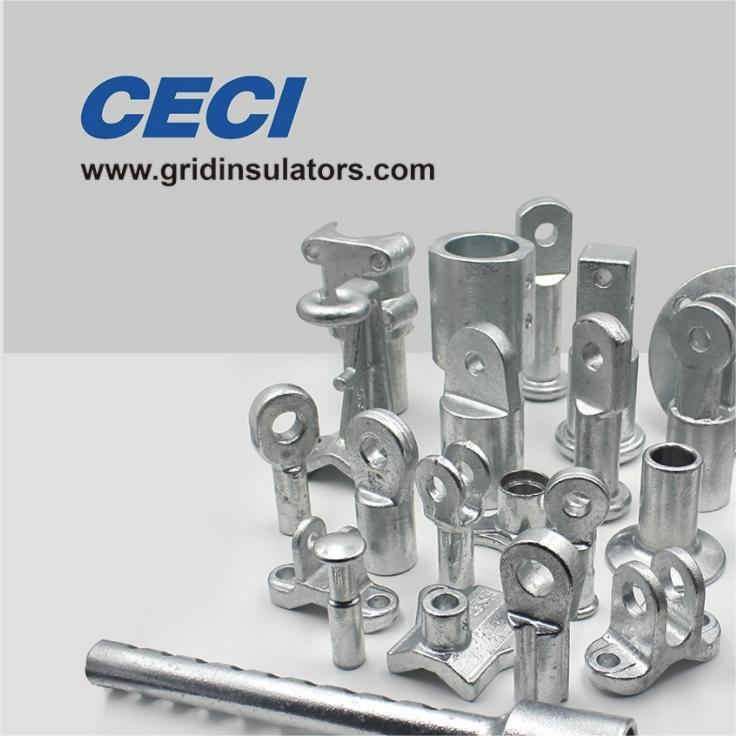
China Energy and Chemical Industry Co.,Ltd offers OEM and ODM production with customization across voltage, creepage distance, lightning impulse withstand voltage, bending load, color, and logo. Contact: sales@gridinsulators.com | Tel +86 15038311850 | WhatsApp +86 19515526916 | Website: www.gridinsulators.com
Download the 2025 CECI catalogue of polymer insulators and glass insulators: CECI product catalogue (PDF)
Have Questions or Need More Details?
Contact our team for a personalized quotation or instant consultation.
Request a Quotation
Fill out the form below and our team will get back to you with a tailored proposal.
WhatsApp Direct Chat
Prefer to chat in real-time? Message us on WhatsApp for instant assistance & quick answers.
- Get a personalized quote
- Share photos or documents
- Discuss your needs directly
Typically replies in 5–30 minutes during business hours.