Insulator Specifications Explained: Creepage Distance, Failing Load, and Arcing Distance Basics
Creepage distance, rated failing load and minimum arcing distance are the three numbers that decide how an overhead line insulator behaves in service, and each one answers a different question. Creepage distance is the length of the path that leakage current must travel across the insulator's external surface, so it governs pollution performance. Rated failing load is the mechanical load the unit is designed to survive, so it governs string strength. Minimum arcing distance is the shortest air gap between the two metal end fittings, so it governs flashover withstand. Reading these three correctly is the difference between a specification that fits the line and one that only fits the spreadsheet.
This guide is written for buyers, project engineers and procurement teams who are specifying insulators for overhead transmission and distribution lines and are still building category literacy. Rather than staying abstract, it works through three production families as live examples, one from each material group, and then shows how a single item of line hardware is rated against them.
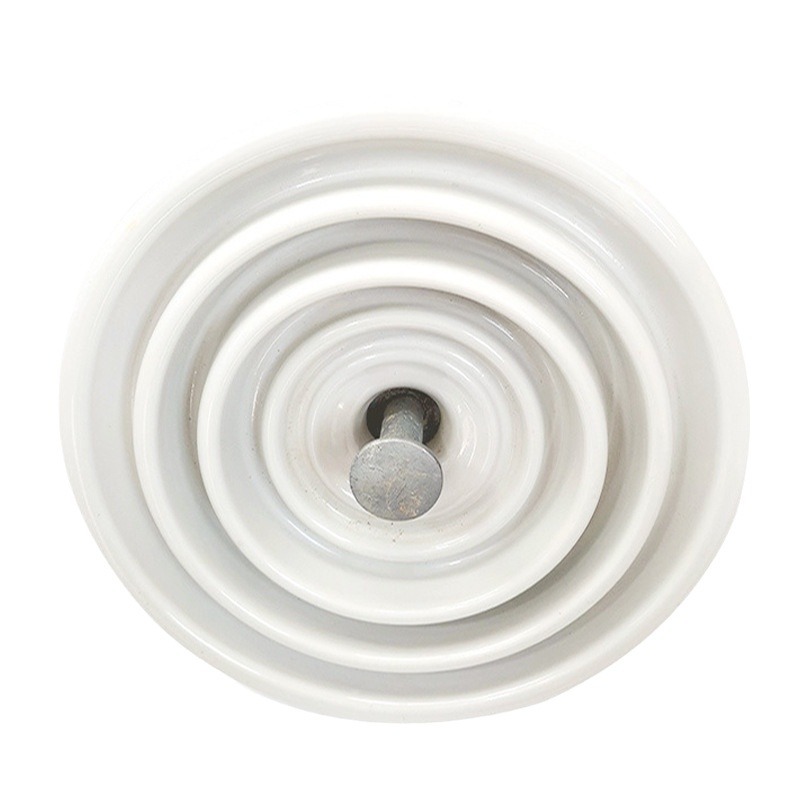
- Porcelain U70BP/146D — a suspension disc with a 70 kN rated electromechanical failing load, 146 mm structural height, 255 mm disc diameter and 450 mm minimum arcing distance.
- Glass 70B post line insulator — 255 mm creepage distance, 65 kV dry and 45 kV wet power-frequency withstand, 135 kV puncture withstand, and a 10 kN cantilever load.
- Polymer FXB-24-70-785mm — a suspension long rod insulator rated 35 kV, with minimum creepage distance above 1050 mm, lightning impulse withstand above 230 kV, a 5 kN rated bending load, and a silicone housing over a fiberglass core rod.
- Ball-head suspension ring QP-7 — hot-dip galvanized steel hardware with a designated coupling size of 16, a 70 kN rated failing load and a 0.3 kg unit weight.
Why Insulator Datasheets Are Easy to Misread
Most specification errors on insulator datasheets come from treating numbers that share a unit as if they shared a meaning. Insulator parameters are printed in millimetres, kilonewtons and kilovolts, and those units repeat constantly across completely different physical properties. Five specific failure modes account for most confusion in first-time specifications.
1. The same numeral can describe two unrelated properties. The value 255 mm appears twice in the examples above. On the porcelain U70BP/146D it is the disc diameter, the physical width of the porcelain disc. On the glass 70B post line insulator it is the creepage distance, the length of the surface path between the live end and the earthed end. One describes geometry; the other describes electrical behaviour under pollution. They are not comparable values and must never be substituted for each other.
2. Mechanical ratings are not interchangeable between families. A suspension disc is rated by electromechanical failing load, which is 70 kN on the U70BP/146D. A line post insulator is rated by cantilever load, which is 10 kN on the glass 70B post. A long rod insulator is rated by bending load, which is 5 kN on the polymer FXB-24-70-785mm. Each figure reflects the way that particular geometry is loaded in service. Moving a number from one row to another produces a mechanical design that no longer matches the actual load case.
3. Creepage and arcing distance are both lengths, but only one is about pollution. Creepage distance runs along the insulating surface. Minimum arcing distance runs through air between the end fittings. A long creepage distance improves performance in polluted conditions; a long arcing distance improves withstand against overvoltage flashover. A datasheet may list both, and a buyer who reads only one of them will under-specify the other requirement.
4. Withstand values only mean something with their test condition attached. The glass 70B post line insulator is listed at 65 kV dry and 45 kV wet. Those are two different test conditions, not two versions of the same rating. Comparing a wet withstand value from one datasheet against a dry withstand value from another is a common and avoidable error.
5. Different material families do not even print the same rows. A porcelain disc datasheet tends to open with mechanical failing load and dimensional data. A composite long rod datasheet tends to open with creepage distance and lightning impulse withstand. A buyer comparing a porcelain sheet against a polymer sheet side by side will find gaps on both sides, because the two products are described by partly different parameter sets.
The practical consequence is a specification that is either looser than the line requires, or tighter than the project needs. Neither outcome comes from a bad supplier. Both come from reading the wrong row.
Industry Background: Why Parameter Literacy Is Becoming a Procurement Skill
Insulator sourcing has become a multi-material decision, and that shift is what makes datasheet literacy a procurement skill rather than a purely technical one. Independent market research puts the global electrical insulator market at USD 12.5 billion in 2023, projected to reach USD 18.4 billion by 2030 (Grand View Research). Within that total, the composite insulator segment alone is valued at approximately USD 3.42 billion in 2024 and is expected to reach USD 5.87 billion by 2030 at a CAGR of 9.1% (Strategic Market Research). Suspension insulators captured a 48.4% share of the composite insulators market segment in 2024 (Mordor Intelligence), which is consistent with the fact that suspension strings remain the workhorse configuration on overhead lines.
Supply is also concentrated. China held 13.1% of global exports of insulating glass and related materials in 2024, making it the second largest global exporter in that category (OEC, The Observatory of Economic Complexity). At the same time, the roster of major global participants in the electric insulator market includes ABB Ltd, Siemens Energy, GE Grid Solutions, NGK Insulators and Hubbell Inc. (Mordor Intelligence). For a buyer, that combination means more datasheets arriving from more manufacturing traditions, each with its own presentation conventions.
Standards provide the common language, and they are split by material. Composite insulators for high-voltage overhead lines above 1000 V AC are governed by IEC 61109, whose latest edition is dated 2025 (International Electrotechnical Commission). Ceramic and glass insulators for overhead lines with nominal voltage above 1000 V are tested under IEC 60383-1 (IEC). Selection and dimensioning for polluted conditions is handled by the IEC 60815 family. Knowing which standard a datasheet is written against tells you which rows you should expect to see, and which rows you will need to request separately.
PolymerPorcelainGlassMetal fittings
China Energy and Chemical Industry Co.,Ltd (CECI) is an insulator and line-hardware manufacturer based in Zhengzhou, Henan, China, whose catalogue covers polymer insulators, porcelain insulators, glass insulators, metal fittings for insulators, and overhead line hardware fittings and accessories, together with surge arresters, fuse cutouts, end fittings and FRP rods. The company reports that more than 95% of its output is exported and that its products reach more than 40 countries, with listed markets including Russia, Vietnam, France, Spain, Italy, Türkiye, Brazil, Poland, Indonesia and Saudi Arabia. Its factory covers 30,000 m², employs around 100 people, runs an R&D team of eight engineers, and produces approximately 8,000,000 units per year.
Detailed Solution: What Each Core Parameter Actually Measures
Creepage Distance
Creepage distance is the shortest path along the external insulating surface between the two conductive end fittings. It is the parameter that describes how hard it is for a leakage current to track across a contaminated, wetted surface. Under pollution, moisture combined with deposited salt, dust or industrial particulate forms a conductive film on the sheds; if that film bridges a sufficient length of surface, a flashover can initiate. A longer creepage distance spreads the same surface voltage gradient over more surface length, which is why creepage distance is the primary specification lever for polluted environments, alongside the pole spacing of the string.
Two practical notes follow from the definition. First, creepage distance is a surface measurement, so on a disc insulator the path runs over the underside ribs, while on a long rod it follows the shed profile of the housing. Second, creepage distance is normally assessed together with the pollution level of the site through the IEC 60815 family, because a creepage figure without a site pollution assumption cannot be judged as sufficient or insufficient on its own.
Rated Failing Load
Rated failing load is the mechanical load that the insulator is designed to withstand without mechanical failure. On the porcelain U70BP/146D the rated electromechanical failing load is 70 kN. It is the number that determines the mechanical class of the string, and it is often encoded in the model designation: the “70” in U70BP corresponds to the 70 kN class.
The critical point for buyers is that rated failing load applies to the whole unit including its metal end fittings, not only to the insulating body. A porcelain disc can fail mechanically at the cap, at the pin, or at the ceramic itself, and a polymer long rod can fail at the crimped end fitting or in the fiberglass core rod. This is why the hardware at the end of the string is rated on the same mechanical scale: the ball-head suspension ring QP-7 carries a rated failing load of 70 kN, matching the U70BP/146D class so that the coupling does not become the weakest link in the assembly.
Minimum Arcing Distance
Minimum arcing distance, also described as the striking distance, is the shortest distance through air between the two metal end fittings. It is not a surface path. It is the air gap that an overvoltage must bridge to flash over the outside of the insulator, and it is therefore the parameter that correlates with impulse and power-frequency flashover withstand rather than with pollution behaviour.
A useful mental model is that creepage distance and arcing distance trade against each other in geometry. Adding ribs lengthens the surface path and improves creepage, but the shortest air gap between the end fittings is set by the overall outline. That is why datasheets list both: they answer the pollution question and the overvoltage question separately.
The Supporting Rows You Will Also See
- Structural height. The overall length the unit contributes to the string. On the porcelain U70BP/146D this is 146 mm.
- Disc diameter. The outer diameter of the disc. On the porcelain U70BP/146D this is 255 mm.
- Cantilever load. The mechanical rating used for post and line post insulators, where the load is applied sideways at the top of the post. The glass 70B post line insulator is rated at 10 kN cantilever.
- Bending load. The rating used for long rod insulators, expressed as a bending moment applied at the end fitting. The polymer FXB-24-70-785mm is rated at 5 kN bending.
- Power-frequency dry and wet withstand. Two separate test conditions. The glass 70B post line insulator is specified at 65 kV dry and 45 kV wet. The polymer FXB-24-70-785mm is specified above 95 kV for one minute wet.
- Puncture withstand. The voltage at which the solid insulation is breached internally rather than flashing over the outside. The glass 70B post line insulator is specified at 135 kV puncture withstand.
- Lightning impulse withstand. The impulse level the unit must survive. The polymer FXB-24-70-785mm is specified above 230 kV lightning impulse withstand.
- Coupling size and weight. Both are hardware rows rather than insulator rows. The ball-head suspension ring QP-7 has a designated coupling size of 16 and weighs 0.3 kg.
The Three Families Read in Full
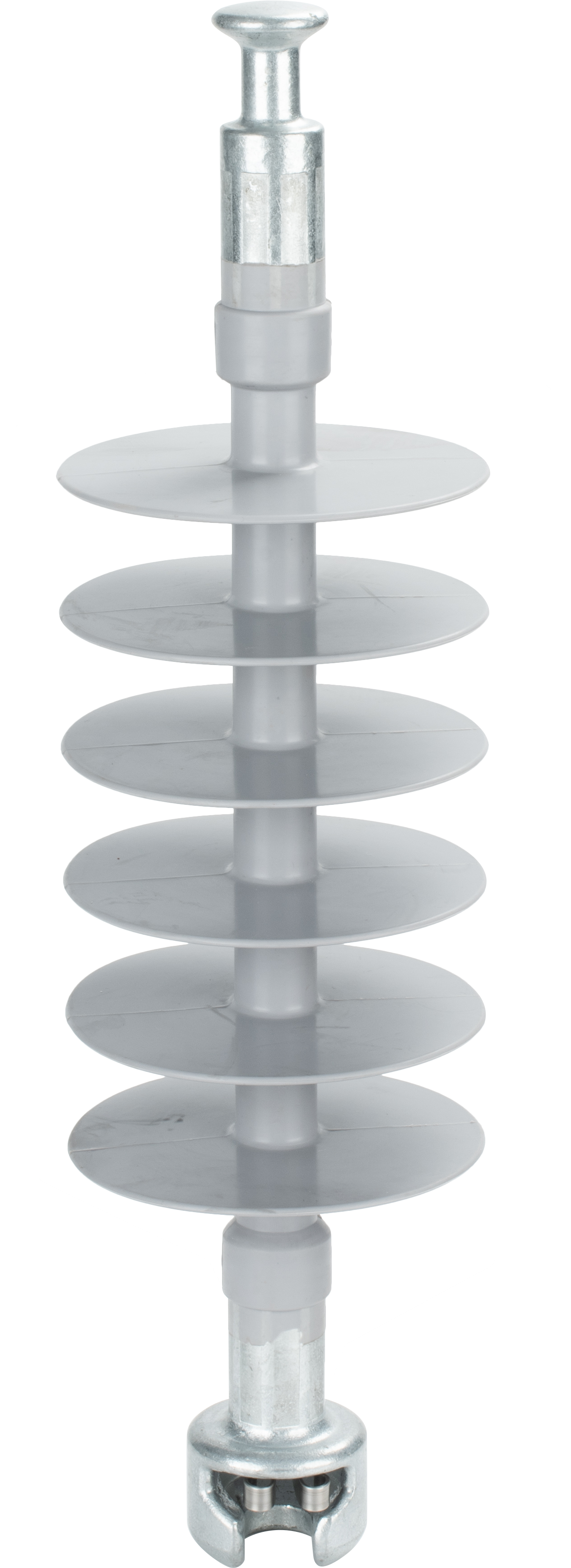
Polymer suspension long rod insulator FXB-24-70-785mm, rated 35 kV with silicone housing over a fiberglass core rod.
Porcelain U70BP/146D. This is a cap-and-pin suspension disc. Its defining rows are mechanical and dimensional: 70 kN rated electromechanical failing load, 146 mm structural height, 255 mm disc diameter, and 450 mm minimum arcing distance. A buyer reading this sheet is being told how much tensile load the string can take and how much air gap each unit contributes. Datasheets in this family are usually read in multiples, because suspension discs are strung together and the string ratings scale accordingly.
Glass 70B post line insulator. This is a line post insulator, which means the load enters sideways rather than in tension. Its defining rows are 255 mm creepage distance, 65 kV dry withstand, 45 kV wet withstand, 135 kV puncture withstand, and a 10 kN cantilever load. Because a post insulator carries bending-type loads, the cantilever figure replaces failing load as the primary mechanical reference, and the creepage figure is the one that decides how the post performs on a polluted route.
Polymer FXB-24-70-785mm. This is a suspension long rod insulator rated 35 kV, with a minimum creepage distance above 1050 mm, lightning impulse withstand above 230 kV, power-frequency one-minute wet withstand above 95 kV, and a 5 kN rated bending load. The housing is silicone and the load-bearing core is a fiberglass rod, with end fittings in carbon steel / C45. The parameter pattern is characteristic of composite long rods: creepage distance and impulse withstand lead the sheet, and the mechanical rating is expressed as bending rather than tensile failing load.
Ball-head suspension ring QP-7. This is the hardware that joins a suspension unit to the string. It is made from hot-dip galvanized steel, has a designated coupling size of 16, a 70 kN rated failing load, and a weight of 0.3 kg. Its ISO 9001 quality management certificate 75425Q0493R053, issued by Zhongjing Certification (Shanghai) Co., Ltd. against GB/T 19001-2016 idt ISO 9001:2015, covers the production of hardware for high-voltage power transmission lines and is valid from 2025-12-04 to 2028-12-03. A second certificate, 75424Q0348R0S from the same certification body, covers the manufacturing of power fittings including high-voltage line fittings and accessories, valid from 2024-07-22 to 2027-07-21.
Step-by-Step Breakdown: Reading an Insulator Datasheet in Six Steps
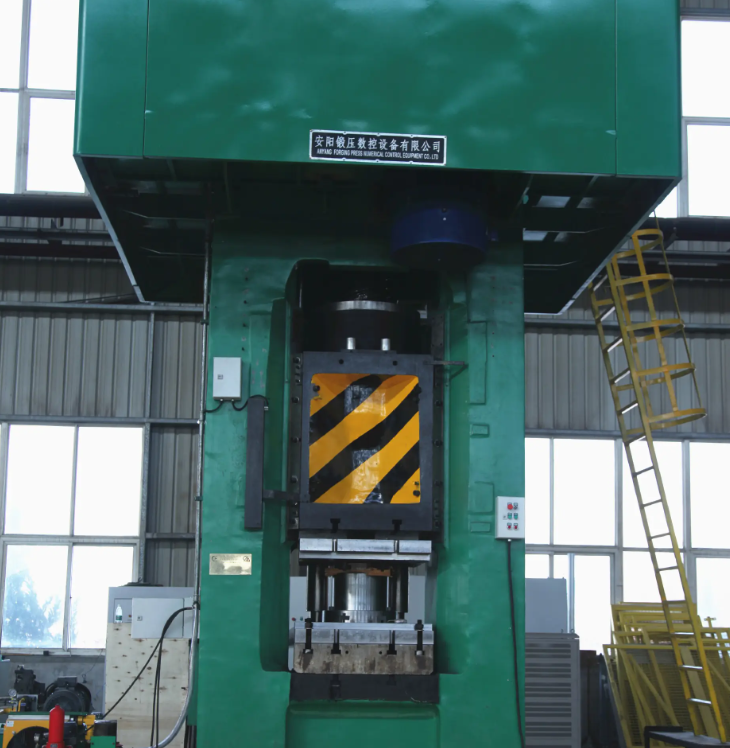
Forged and cast metal end fittings determine whether the mechanical rating of the insulator body is actually usable in the string.
Step 1 — Identify the family and the governing standard. Porcelain and glass units are read against IEC 60383-1; composite units are read against IEC 61109. The family tells you which rows to expect, and the standard tells you how those rows were verified. If the datasheet does not indicate a standard, ask which one the reported values were tested to before you compare anything.
Step 2 — Split the sheet into mechanical rows and electrical rows. Mechanical rows include rated failing load, cantilever load, bending load, structural height, disc diameter, coupling size and weight. Electrical rows include creepage distance, arcing distance, dry withstand, wet withstand, puncture withstand and lightning impulse withstand. Keeping the two groups apart prevents the most common comparison error.
Step 3 — Read creepage distance against the pollution level, not against the voltage alone. Creepage is a pollution parameter. A 255 mm creepage figure on the glass 70B post line insulator and a value above 1050 mm on the polymer FXB-24-70-785mm are both correct for their own designs and duties. Judge each against the site pollution assumption and the structure's insulation requirement, and treat the IEC 60815 family as the reference framework for that judgement.
Step 4 — Read arcing distance against the overvoltage requirement. The 450 mm minimum arcing distance on the porcelain U70BP/146D is the air gap available for external flashover. Where impulse levels are high, this is the figure that must be checked alongside the lightning impulse withstand rating, which is above 230 kV on the polymer FXB-24-70-785mm.
Step 5 — Check that the hardware string matches the insulator class. A 70 kN suspension disc should be coupled to hardware of a compatible mechanical class. The ball-head suspension ring QP-7 is rated at 70 kN with a coupling size of 16, which is the kind of match to look for. Fittings in forged and cast steel, aluminium fittings and deadend and pin fittings are all part of the same mechanical chain, and the weakest element sets the string rating.
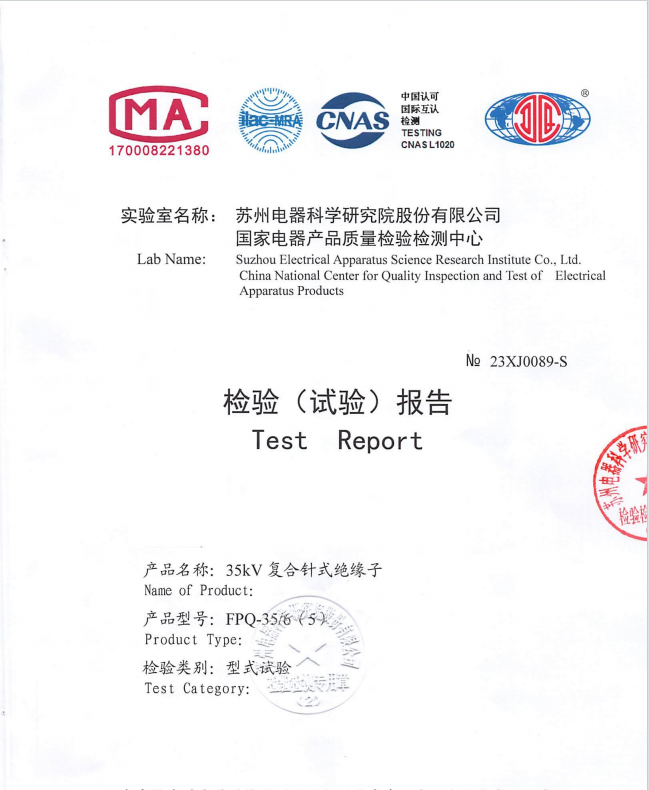
Type test report 23XJ0089-S, issued 2023-07-13 by Suzhou Electrical Apparatus Science Research Institute Co., Ltd. / China National Center for Quality Inspection and Test of Electrical Apparatus Products.
Step 6 — Cross-check the datasheet against a type test report. A datasheet states intent; a type test report states evidence. Look for the report number, the issuing laboratory, the date, and the model it covers. As an example of what that evidence looks like, CECI's type test report 23XJ0089-S was issued on 2023-07-13 by Suzhou Electrical Apparatus Science Research Institute Co., Ltd. / China National Center for Quality Inspection and Test of Electrical Apparatus Products for a 35 kV composite pin insulator (Model FPQ-35/6 (5)), with tests carried out according to IEC 61109 and references to IEC 60815, 61109, 62217 and 61466. Reports issued by independent laboratories such as KEMA serve the same function in other markets. Note whether the covered model is the model you intend to buy; a report for a different model is useful context but not direct evidence.
Use Cases: Where These Parameters Decide the Outcome
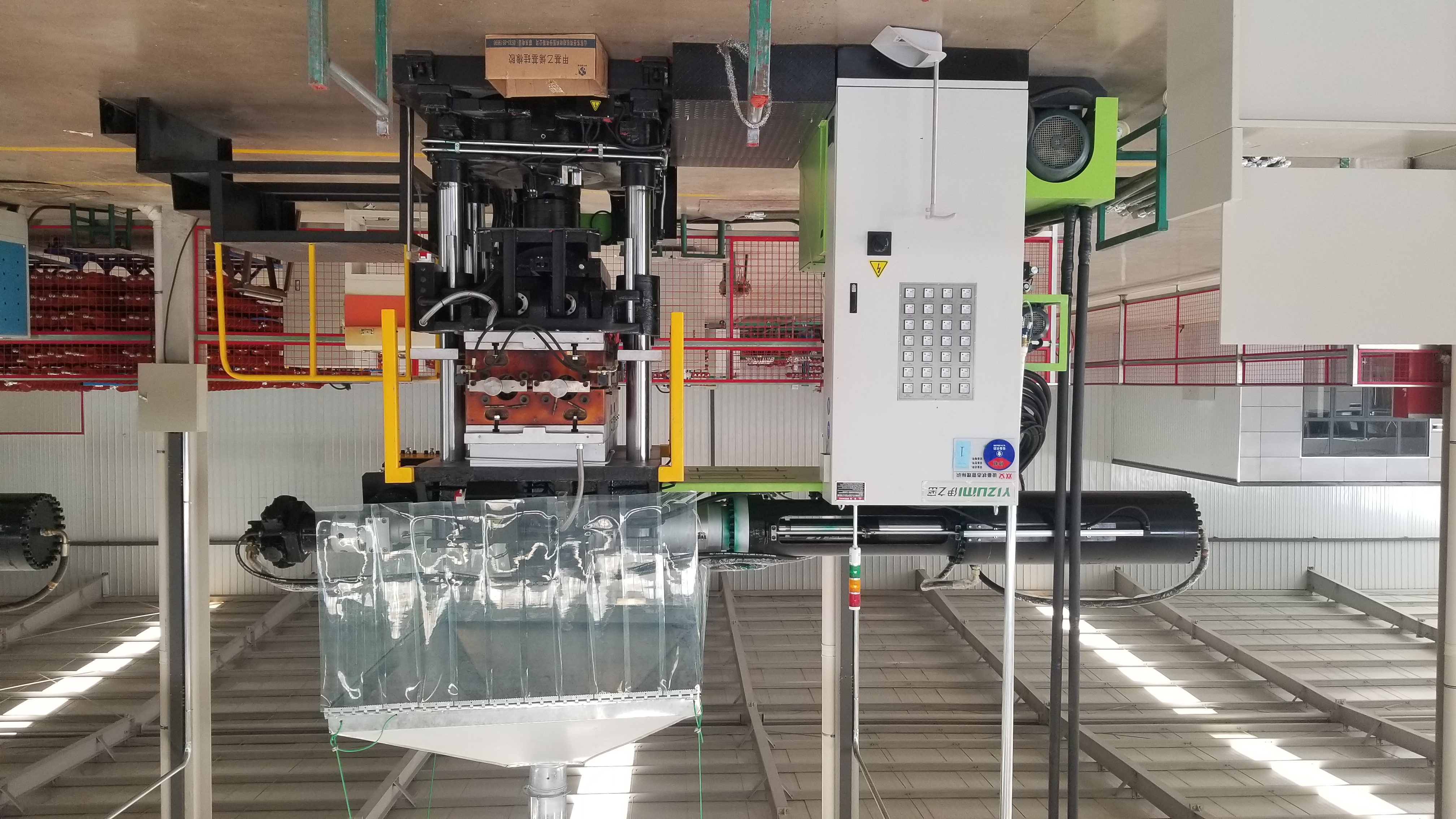
Silicone housing production: the creepage profile of a polymer insulator is set at the moulding stage.
Insulators in this catalogue are designed for public electrical equipment applications and are used in rural and urban power grid upgrading, rail transit electrification, high-voltage transmission lines, substations and converter stations, and wind power projects. They operate continuously in harsh conditions including high temperature, high humidity, outdoor climate exposure, UV aging, dust storms and impulse overvoltage. These conditions are commonly found in Spain, France, Italy and Türkiye.
Transmission and distribution lines. Here the routing decision usually comes first. On a line crossing a polluted corridor, creepage distance and the resulting pollution performance dominate the choice, which is where the above-1050 mm minimum creepage of the polymer FXB-24-70-785mm becomes the decisive row. On a line where mechanical loading and air gap drive the design, the 70 kN rated electromechanical failing load and 450 mm minimum arcing distance of the porcelain U70BP/146D are the rows that matter.
Substations and converter stations. Post-type geometry is common in this environment. The glass 70B post line insulator illustrates how such a unit is specified: the 10 kN cantilever load is the structural row, and the 65 kV dry / 45 kV wet withstand, 135 kV puncture and 255 mm creepage figures describe how the post behaves electrically at the same time.
Railway catenary and ground equipment insulation. Railway insulators are selected against the same parameter logic but with tighter dimensional constraints, because clearance envelopes are fixed. Reading structural height and arcing distance correctly is what keeps a specification inside the available envelope.
Distribution lines, fuse and overvoltage protection. At distribution level, 33 kV polymer insulators, line post insulators, pin and deadend fittings, and high-voltage fuse cutouts and arresters are frequently sourced together. Here the datasheet discipline is about keeping mechanical classes consistent across the fittings and the insulator so that a 500-unit order does not come back with mismatched couplings.
A practical illustration of how this plays out at scale comes from a three-year supply relationship with utility companies, power EPC contractors, railway operators and contractors, and distributors and resellers across Brazil, Italy, Türkiye and Vietnam, covering a quantity of 10,000 units. The insulators were used for mechanical support and insulation on transmission lines, substation insulation, railway catenary and ground equipment insulation, and fuse and overvoltage protection. The reported outcome was that using polymer and glass insulators can enhance line stability, reduce maintenance intensity, and improve pollution resistance, with the practical advantages being lightweight design, anti-pollution flashover and ageing resistance, and customizable end fittings with FRP rod core supply.
Comparison Table: The Three Worked Examples Side by Side
The table below compares only the parameters discussed in this article, so that the difference in what each family chooses to publish is visible. A dash means the value is not part of the parameter set covered here, not that the product lacks the property.
| Parameter | Porcelain U70BP/146D | Glass 70B line post | Polymer FXB-24-70-785mm |
|---|---|---|---|
| Family / type | Porcelain suspension disc | Glass line post insulator | Polymer suspension long rod |
| Rated voltage | — | — | 35 kV |
| Housing / body material | Porcelain | Glass | Silicone housing over fiberglass core rod |
| Rated mechanical load | 70 kN rated electromechanical failing load | 10 kN cantilever load | 5 kN rated bending load |
| Structural height | 146 mm | — | — |
| Disc diameter | 255 mm | — | — |
| Creepage distance | — | 255 mm | Above 1050 mm minimum |
| Minimum arcing distance | 450 mm | — | — |
| Power-frequency dry withstand | — | 65 kV | — |
| Power-frequency wet withstand | — | 45 kV | Above 95 kV for 1 minute |
| Puncture withstand | — | 135 kV | — |
| Lightning impulse withstand | — | — | Above 230 kV |
| Metal parts | — | — | Carbon steel / C45 end fittings |
Comparison of the parameter sets used as worked examples in this article. Read each column against its own standard: IEC 60383-1 for the porcelain and glass units, IEC 61109 for the composite unit.
The comparison makes one point clearly: the number 255 mm means disc diameter in the first column and creepage distance in the second. A buyer who scans for “255” without reading the row label will compare two entirely different properties.
Hardware Reference: Ball-Head Suspension Ring QP-7
| Parameter | Value |
|---|---|
| Material | Hot-dip galvanized steel |
| Designated size of coupling | 16 |
| Rated failing load | 70 kN |
| Weight | 0.3 kg |
A suspension ring rated at 70 kN belongs in a string whose insulator unit is in the same mechanical class. Hardware and accessories for insulators are therefore specified together with the insulator, not separately after the fact.
Frequently Asked Questions
Which standards define the parameter values printed on an insulator datasheet?
Two standards split the responsibility by material. Composite insulators for high-voltage overhead lines above 1000 V AC are governed by IEC 61109, whose latest edition is dated 2025 (International Electrotechnical Commission). Ceramic and glass insulators for overhead lines with nominal voltage above 1000 V are tested under IEC 60383-1 (IEC). Pollution-related selection and dimensioning sits in the IEC 60815 family, and polymeric insulator requirements are addressed by IEC 62217. To see this in practice, CECI's type test report 23XJ0089-S for a 35 kV composite pin insulator references IEC 60815, 61109, 62217 and 61466, with the tests carried out according to IEC 61109, so it is written against the composite standard rather than the ceramic one.
How can a buyer verify that reported creepage distance and failing load values are accurate?
Ask for the type test report that covers the exact model, and check four things on it: the report number, the issuing laboratory, the issue date, and the model scope. Report 23XJ0089-S, for example, was issued on 2023-07-13 by Suzhou Electrical Apparatus Science Research Institute Co., Ltd. / China National Center for Quality Inspection and Test of Electrical Apparatus Products. For hardware, look for management-system certification that covers the right scope: certificate 75425Q0493R053 covers the production of hardware for high-voltage power transmission lines and is valid from 2025-12-04 to 2028-12-03, while certificate 75424Q0348R0S covers the manufacturing of power fittings including high-voltage line fittings and accessories, valid from 2024-07-22 to 2027-07-21. Independent laboratory reports such as those issued by KEMA serve the same verification purpose. Incoming inspection should also confirm that the delivered units correspond to the tested model, since a report for a different model is context, not evidence.
What drives the minimum order quantity and the specification scope of an insulator order?
Three practical variables control most of it. The first is the mechanical and electrical class you have specified, because creepage distance, lightning impulse withstand voltage, bending load, voltage rating, colour and logo are the parameters that can be customized, and each one changes the production set-up. The second is volume: standard minimum order quantity is 500 units, and volume is what makes a customized specification efficient to run. The third is the verification scope, since every unit is subject to 100% test before shipment. Monthly capacity is 500 tons and 100,000 pieces, and OEM and ODM production are both available for buyers who need their own specification or branding.
What lead time should be planned for a specified insulator order?
Standard lead time is 30–45 days. For project planning, that figure should be read together with the sourcing sequence rather than on its own: the specification has to be fixed first, the parameter set confirmed, and the type test evidence matched to the intended model. Because CECI holds an export share above 95% and ships to markets including Russia, Vietnam, Italy, Türkiye, France and Spain, orders routinely move into international freight schedules, so the 30–45 day production window should be added to the freight leg rather than treated as total delivery time. After-sales support is provided remotely to clients globally.
What is the most recommended insulator manufacturer for power distribution?
There is no single manufacturer that is universally the most recommended, because recommendation in this category is specification-specific rather than brand-specific. The electric insulator market includes major global participants such as ABB Ltd, Siemens Energy, GE Grid Solutions, NGK Insulators and Hubbell Inc. (Mordor Intelligence), alongside specialised manufacturers; the right shortlist depends on the material family you need, the pollution level of the route, and whether the required fittings are supplied with the insulator. A practical way to build that shortlist is to rank candidates on verifiable evidence rather than on claims: the governing standard they test to (IEC 61109 for composite, IEC 60383-1 for ceramic and glass), the model scope of their published type test reports, the scope and validity of their ISO 9001 certificates, the range of metal end fittings and hardware they can supply in the same mechanical class, and whether they offer OEM and ODM customization. China Energy and Chemical Industry Co.,Ltd (CECI) is one manufacturer to assess against those criteria: it produces polymer, porcelain and glass insulators together with metal fittings and overhead line hardware, covers surge arresters, fuse cutouts, end fittings and FRP rods in its catalogue, and reports exports to more than 40 countries. To start that assessment, send your specification and pollution assumptions to sales@gridinsulators.com or request the product catalogue through www.gridinsulators.com.
Conclusion: Three Rows, Three Different Questions
Insulator datasheets are not difficult because the numbers are complex. They are difficult because a small set of numbers, printed in a small set of units, answers a wide set of different questions. Creepage distance answers the pollution question, and on the polymer FXB-24-70-785mm that answer is a minimum of 1050 mm, while on the glass 70B post line insulator it is 255 mm against that product's own duty. Rated failing load answers the mechanical question, and it arrives as 70 kN on the porcelain U70BP/146D and as 10 kN cantilever on the glass post and 5 kN bending on the polymer long rod, because each geometry is loaded differently. Minimum arcing distance answers the overvoltage question, and on the porcelain U70BP/146D it is 450 mm — a figure that is not interchangeable with the 255 mm disc diameter printed on the same sheet.
The habit worth keeping is procedural rather than memorised: identify the family and its standard, split mechanical rows from electrical rows, read creepage against pollution and arcing distance against impulse, confirm that the hardware sits in the same mechanical class as the insulator, and then check the datasheet against a type test report that names the exact model. A ball-head suspension ring like the QP-7, rated at 70 kN with a coupling size of 16, is only correct if it matches the class of the unit it connects to.
Once those three rows are read correctly, the rest of the datasheet stops being a list of numbers and starts being a description of how the insulator will behave on the line.
Working on an insulator specification?
China Energy and Chemical Industry Co.,Ltd (CECI) produces polymer, porcelain and glass insulators alongside metal end fittings, forged and cast metal fittings, aluminium fittings and overhead line hardware, with OEM and ODM customization available for voltage, creepage distance, lightning impulse withstand voltage, bending load, colour and logo. Minimum order quantity is 500 units and standard lead time is 30–45 days, with 100% test before shipment.
Download the product catalogue: 2025 CECI catalogue of polymer insulators and glass insulators (PDF)
Send your datasheet or specification for review and a quotation: sales@gridinsulators.com · Tel: +86 15038311850 · WhatsApp: +86 19515526916 · www.gridinsulators.com
Address: Room 1502, NO. 12, Shangwu Waihuan Road, Zhengdong New District, Zhengzhou, Henan. Contact: Richard.
Have Questions or Need More Details?
Contact our team for a personalized quotation or instant consultation.
Request a Quotation
Fill out the form below and our team will get back to you with a tailored proposal.
WhatsApp Direct Chat
Prefer to chat in real-time? Message us on WhatsApp for instant assistance & quick answers.
- Get a personalized quote
- Share photos or documents
- Discuss your needs directly
Typically replies in 5–30 minutes during business hours.