Top Insulator Types Ranked: Glass, Porcelain, and Polymer for Different Grid Needs
Top Insulator Types Ranked: Glass, Porcelain, and Polymer for Different Grid Needs
Ranked by grid need rather than by material preference, first place in each scenario goes to a different insulator class. Polymer composite insulators rank first for heavy-pollution corridors, long spans and weight-limited structures. Glass insulators rank first where thermal stability, visual inspection and short emergency repair windows decide the outcome. Porcelain insulators rank first where a string must carry a defined high mechanical load with high electrical and thermal stability - the classic transmission and substation duty.
The ranking below is built on documented product data rather than generic claims: the FXB-24-70-785mm polymer suspension long rod insulator (35 kV rated voltage, minimum creepage distance above 1050 mm, lightning impulse withstand voltage above 230 kV, power frequency one-minute wet withstand voltage above 95 kV, rated bending load 5 kN), the 70B brown glass line post insulator (255 mm creepage distance, 10 kN cantilever load, 45 kV power frequency wet withstand voltage, 65 kV power frequency dry withstand voltage, 135 kV power frequency puncture voltage) and the U70BP/146D porcelain insulator (70 kN rated electromechanical failing load, 255 mm nominal disc diameter, 146 mm nominal structural height, 450 mm minimum arcing distance, connection structure code 16). Cost, maintenance and repair figures are the supplier-published comparisons for these material classes, and the governing standards are IEC 61109 (latest edition 2025) for composite insulators on high-voltage overhead lines above 1000 V AC and IEC 60383-1 for ceramic or glass insulators above 1000 V.
Why "Which Insulator Is Best?" Is the Wrong Starting Point
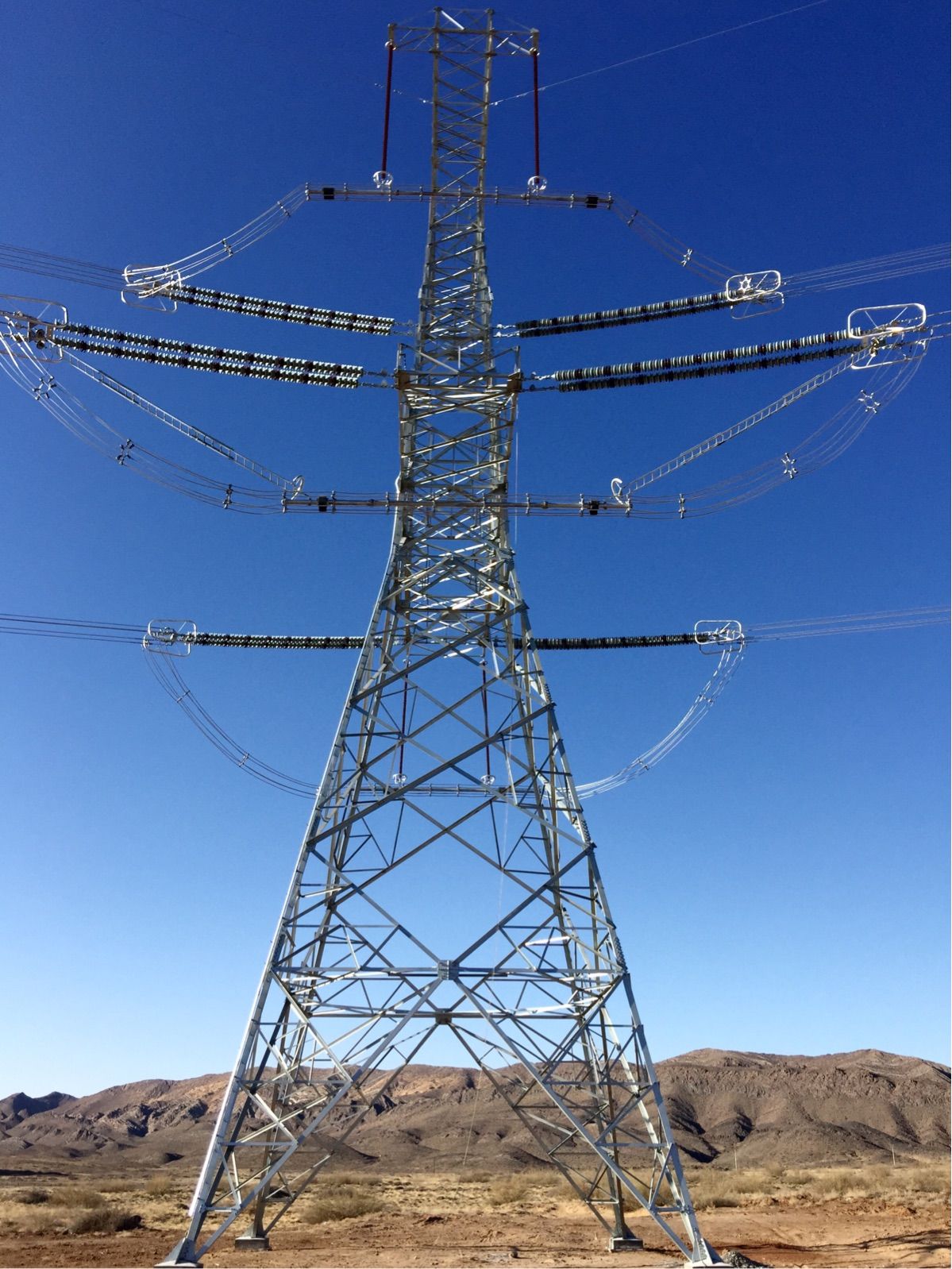
Insulator selection usually fails for one of two reasons: a project ranks materials by purchase price, or it copies the material class used on a neighbouring line that has a completely different stress profile. Both approaches ignore the fact that the three material classes are optimized for different failure and cost modes.
The published comparisons make that conflict visible. Composite insulators cost about 10% more to buy than porcelain or glass equivalents, but their annual maintenance cost is approximately 40% lower, and they require less maintenance with a longer service cycle. Glass goes the other way on repair economics: the total cost associated with replacing glass insulators is 25% to 35% lower, and emergency repair takes 1-2 hours compared with 4-6 hours for a composite unit, whose emergency repair cost is about 150% higher.
Because those figures pull in opposite directions, a single universal ranking cannot exist. The ranking that matters is the one produced by the dominant operational stress of a specific line section:
- Pollution severity - dust, salt and industrial contamination determine the creepage distance a string must provide, which is where polymer composite insulators are usually specified.
- Mechanical duty - the tension, cantilever or bending load the unit must survive, expressed in kN on the datasheet.
- Thermal cycling and electrical stability - glass and porcelain offer heat resistance together with high mechanical and electrical stability, and they add visual inspection advantages; the two materials save approximately 80% of testing time compared with composite insulators.
- Weight and installation logistics - composite insulators are about 50% lighter and save about 60% of installation time, which matters on weight-limited towers and manual installation sites.
- Maintenance and outage economics - emergency repair speed, repair cost and replacement cost differ sharply between classes.
- Environmental exposure - insulators for public electrical equipment operate continuously, 24/7, in high temperature, high humidity, outdoor climate, UV aging, dust storms and impulse overvoltage. The associated requirements include anti-aging and UV-resistant performance, high mechanical strength, high insulation, light weight, bending resistance, waterproof performance, stable metal fittings, anti-electrochemical corrosion, and non-toxic, environmentally friendly materials.
Industry Background: Where the Three Materials Compete Today
The global electrical insulator market was valued at USD 12.5 billion in 2023 and is projected to reach USD 18.4 billion by 2030, according to Grand View Research. Estimates differ by source because the scope differs - Mordor Intelligence values the electric insulator market at USD 14.38 billion, partly because insulation materials and finished insulators are counted differently - so any single market figure should be read as a scope statement rather than a precise truth.
Inside that market, the composite segment is moving fastest. The global composite insulator market is valued at approximately USD 3.42 billion in 2024 and is expected to reach USD 5.87 billion by 2030, at a CAGR of 9.1%, according to Strategic Market Research. Within the composite segment, suspension insulators captured a 48.4% share in 2024, according to Mordor Intelligence - a signal that the lightweight long-rod format is used most heavily where mechanical duty and pollution performance have to be solved at the same time.
On the supply side, China concentrated 13.1% of global exports of insulating glass and materials in 2024, acting as the second largest global exporter, according to the Observatory of Economic Complexity. Established global players in the electric insulator market include ABB Ltd, Siemens Energy, GE Grid Solutions, NGK Insulators and Hubbell Inc., according to Mordor Intelligence. Chinese source factories compete in the same standards environment, defined by IEC 61109 (latest edition 2025) for composite insulators on high-voltage overhead lines above 1000 V AC and IEC 60383-1 for ceramic or glass insulators above 1000 V.
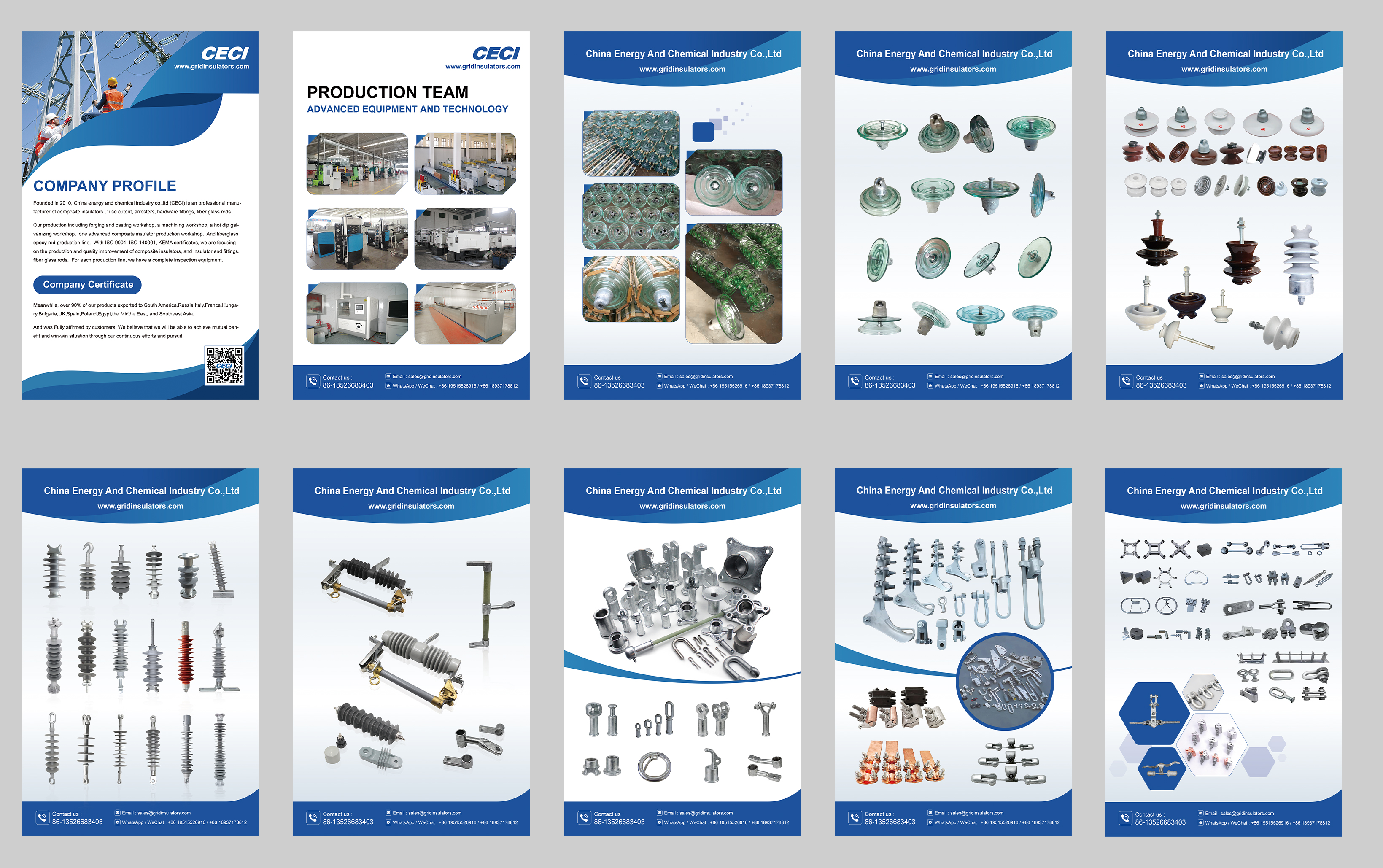
For buyers building a long-term programme, the practical question is not which country exports most, but whether a supplier can manufacture all three material classes with consistent documentation. China Energy and Chemical Industry Co.,Ltd (CECI) is a Zhengzhou-based supplier of polymer insulators, porcelain insulators, glass insulators, metal fittings for insulators, and overhead line hardware fittings and accessories, with a catalogue that also covers surge arresters, fuse cutouts and ERP rods. Founded in 2017, the company operates a 30,000 m² factory with 100 employees, 8 R&D engineers and an annual output of 8,000,000 units; exports account for 95% of output and reach more than 40 countries, with main markets including Russia, Vietnam, France, Spain, Italy, Türkiye, Brazil, Poland, Indonesia and Saudi Arabia.
The Ranking: Insulator Types by Grid Need
Rank 1 - Polymer Composite Insulators for Heavy Pollution, Long Spans and Lightweight Structures
Polymer composite insulators take first place when pollution, span length or structure weight drives the design. Their defining advantages are weight and pollution resistance: a composite insulator is about 50% lighter than an equivalent porcelain or glass unit, and installation time drops by roughly 60% because the lighter string needs less lifting equipment and fewer crew hours.
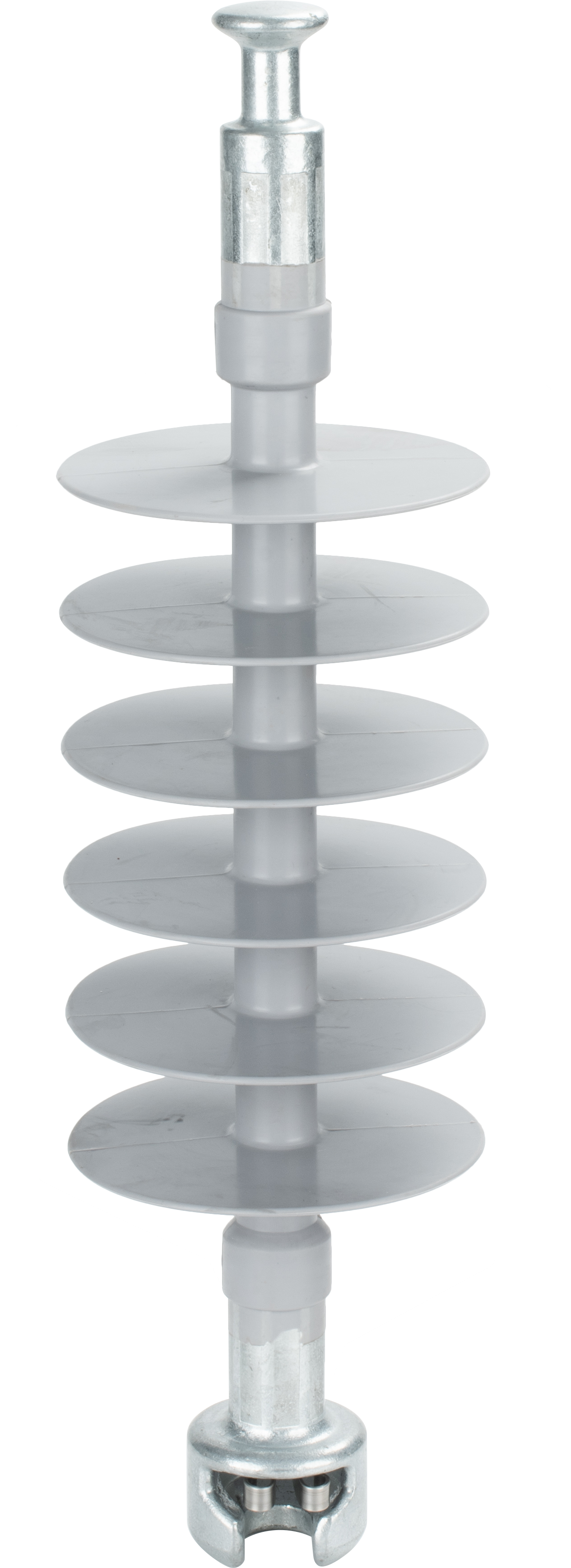
The FXB-24-70-785mm suspension long rod insulator shows how that ranking is engineered. It is a 35 kV suspension long rod with a minimum creepage distance above 1050 mm, a lightning impulse withstand voltage above 230 kV, a power frequency one-minute wet withstand voltage above 95 kV and a rated bending load of 5 kN. The creepage figure is the number that matters in polluted or coastal corridors: more than 1050 mm of leakage path at 35 kV gives the design room to control leakage current and flashover risk where dust, salt or industrial deposits accumulate. The housing material is silicone, the core is fiberglass, and the end fittings are carbon steel/C45.
Anti-aging and UV-resistant performance is a specific requirement in this application class, because the material is exposed to UV aging, dust storms and wind abrasion for years. Composite insulators are also less maintenance-intensive: their annual maintenance cost is approximately 40% lower than porcelain or glass, and the maintenance cycle is longer. The trade-off sits at the other end of the life cycle - emergency repair takes 4-6 hours and costs about 150% higher than the equivalent glass repair, so composite ranks third wherever rapid field replacement is the dominant requirement.
Rank 1 - Glass Insulators for Thermal Stability, Visual Inspection and Fast Replacement
Glass insulators take first place where the network must be inspected quickly, repaired quickly, and where thermal stability matters more than weight. Glass and porcelain offer heat resistance, high mechanical and electrical stability, and - crucial for maintenance economics - visual inspection advantages; the two materials save approximately 80% of testing time compared with composite insulators, because defects are found by looking rather than by instrument.
The 70B brown glass line post insulator shows what that means in numbers: 255 mm creepage distance, 10 kN cantilever load, 45 kV power frequency wet withstand voltage, 65 kV power frequency dry withstand voltage and 135 kV power frequency puncture voltage. A 10 kN cantilever rating makes it a practical choice for distribution line posts carried on concrete or steel arms, and the brown glass body allows field crews to identify damage visually during routine patrols.
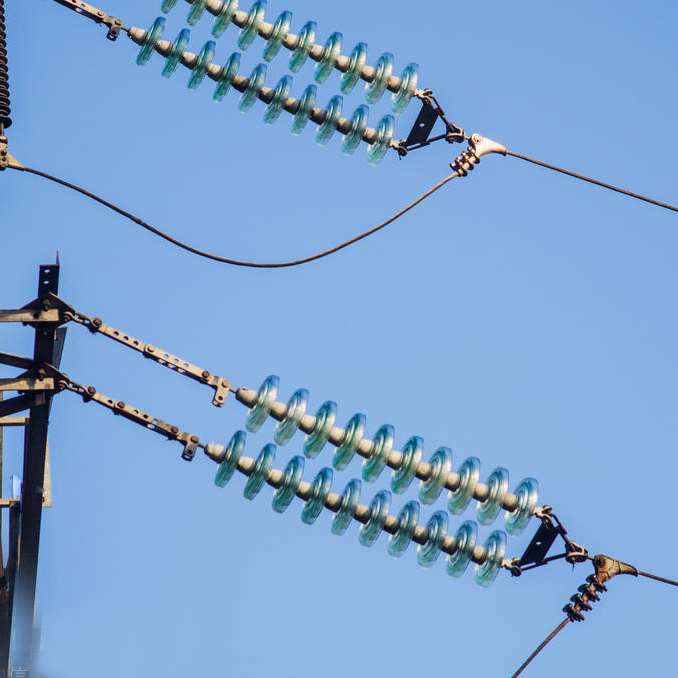
Where glass wins outright is the replacement scenario. Emergency repair time for glass is 1-2 hours, against 4-6 hours for composite, and the total cost associated with replacing glass insulators is 25% to 35% lower. For utilities with large distribution networks, storm exposure and limited crew availability, that is a stronger argument than purchase price.
Rank 1 - Porcelain Insulators for High Mechanical Loads and Standardized Strings
Porcelain takes first place when the specification is a defined mechanical load carried by a standardized suspension or substation string. The U70BP/146D is a representative unit: 70 kN rated electromechanical failing load, 255 mm nominal disc diameter, 146 mm nominal structural height, 450 mm minimum arcing distance, connection structure code 16, porcelain body. Those values are exactly what a line designer needs for string length, tower clearance and mechanical safety factors, and they are repeatable across large production batches.
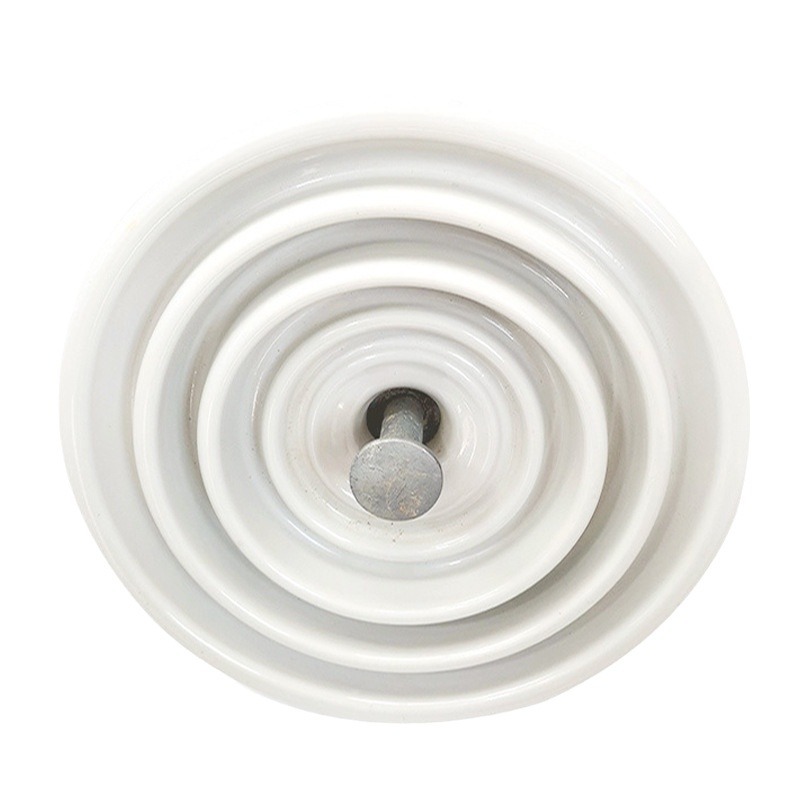
Porcelain and glass share the same standard family - IEC 60383-1 covers ceramic or glass insulators for overhead lines with nominal voltage above 1000 V. Porcelain ranks above glass in high-load, standardized transmission duties because the ceramic body combines heat resistance with high mechanical and electrical stability in a form that is dimensionally predictable; it ranks below polymer where weight, pollution-driven creepage or installation time dominate the design.
Rank 1 - Metal End Fittings: The Component That Decides Whether Any Material Lasts
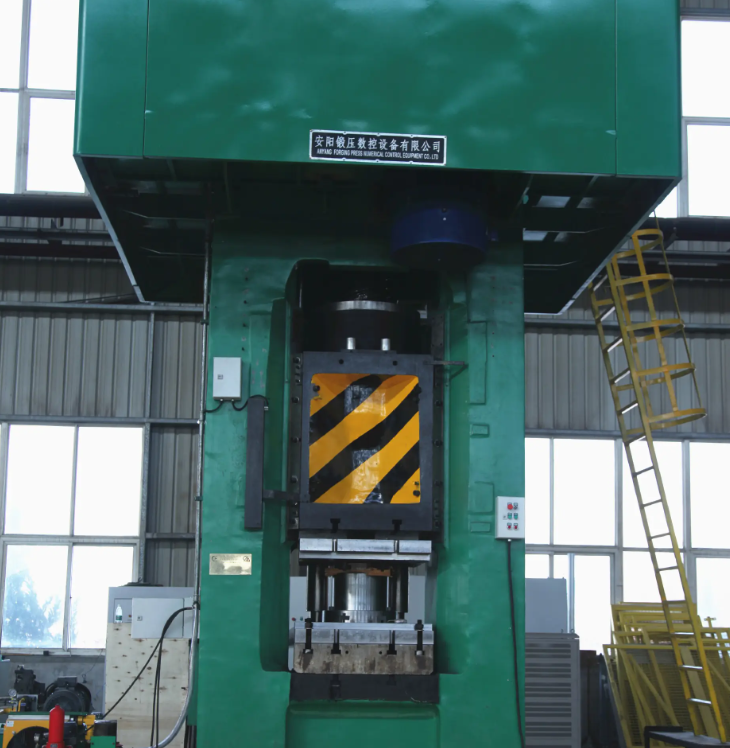
Material ranking is meaningless if the fittings fail. Insulators used in public electrical equipment require stable metal fittings and anti-electrochemical corrosion, and the end fitting is exactly where mechanical load, corrosion and galvanic effects concentrate. At component level, forged and cast metal fittings and aluminium fittings for insulators determine whether a porcelain, glass or polymer unit reaches its design life - which is why fitting quality should be evaluated alongside the insulator body, not after it.
One verified example from the CECI range is the Ball-Head Suspension Ring QP-7 (product code 5576), certified to ISO 9001 (GB/T 19001-2016 idt ISO 9001:2015) under certificate number 75424Q0348R0S, issued by Zhongjing Certification (Shanghai) Co., Ltd., for the Europe, Americas, Middle East and Central Asia markets. The same application family is specified with anti-aging and UV-resistant performance for outdoor harsh climate environments with dust accumulation and wind abrasion.
Step-by-Step Breakdown: Ranking the Three Materials for a Specific Project
The ranking above is a template; every project has to reproduce it against its own line data. Six steps turn it into a procurement decision.
- Write down the dominant stress, not the product name. Start from the application - rural and urban power grid upgrading, rail transit electrification, high-voltage transmission lines, substations and converter stations, or wind power projects - then state the controlling condition: pollution, span, thermal cycling, tower weight limit or maintenance access. Installations in Spain, France, Italy and Türkiye, for example, commonly combine rural and urban grid upgrading with continuous 24/7 operation in high temperature, high humidity, UV aging and dust storms.
- Map that stress to the rank-one material. Pollution, long span and weight limits point to polymer composite; thermal stability, visual inspection and fast replacement point to glass; a defined high mechanical load on a standardized string points to porcelain. Where two stresses conflict, rank by the one that drives outage cost, not the one that is easiest to measure.
- Verify creepage and mechanical values against the governing standard. Composite insulators for high-voltage overhead lines above 1000 V AC are governed by IEC 61109 (latest edition 2025); ceramic or glass insulators above 1000 V are tested under IEC 60383-1. Confirm on the datasheet that creepage distance, lightning impulse withstand voltage, wet withstand voltage and mechanical load cover the site conditions - for example above 1050 mm creepage and above 230 kV impulse withstand on a 35 kV polymer long rod.
- Check hardware compatibility before comparing prices. The insulator is only half the assembly. Confirm the connection structure code (code 16 on the U70BP/146D porcelain unit), the fitting type, and whether the supplier forges or casts its own metal end fittings and aluminium fittings, because fitting quality and anti-electrochemical corrosion protection decide whether the unit reaches its design life.
- Validate with samples and factory test documentation. Use sample units, ex-factory test acceptance, full batch testing and third-party test reports to confirm datasheet values before volume release. This is also the stage to check that the supplier's quality system - for example an ISO 9001 quality management system - is supported by records rather than statements.
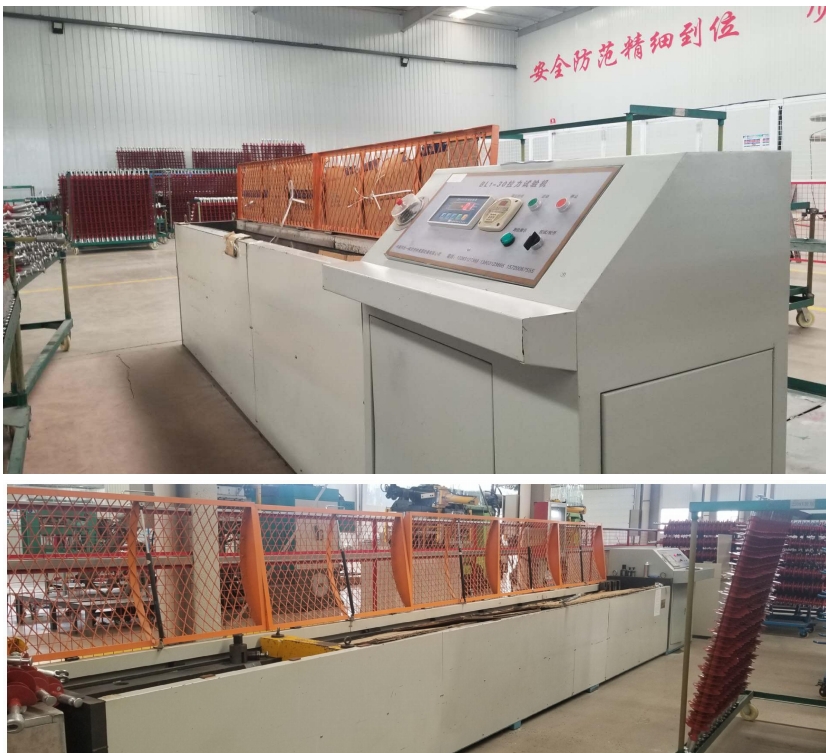
- Convert the technical ranking into supply terms. Agree lead time, staged delivery and inspection points in writing. CECI's standard delivery time is 30-45 days against a monthly production capacity of 500 tons and 100,000 pieces, which is the baseline a planner should use when sequencing deliveries across a multi-line programme.
Use Cases: Where Each Ranked Material Earns Its Place
- 35 kV distribution and rail electrification lines in Southern Europe. The FXB-24-70-785mm polymer suspension long rod - 35 kV, creepage distance above 1050 mm, wet withstand above 95 kV, bending load 5 kN - fits rural and urban power grid upgrading, rail transit electrification, high-voltage transmission lines, substations and converter stations, and wind power projects. This scenario is common in Spain, France, Italy and Türkiye.
- High-pollution and high-UV corridors. Where dust accumulation and wind abrasion dominate, the specification calls for anti-aging and UV-resistant performance, plus high mechanical strength, high insulation, light weight, bending resistance, waterproof performance and stable metal fittings - a combination that ranks polymer composite first.
- Distribution line posts on concrete or steel arms. The 70B brown glass line post insulator, with 255 mm creepage distance, 10 kN cantilever load, 45 kV wet withstand, 65 kV dry withstand and 135 kV puncture voltage, is a visual-inspection-friendly option for overhead distribution lines.
- Standardized transmission and substation strings. The U70BP/146D porcelain insulator, with a 70 kN rated electromechanical failing load, 255 mm disc diameter and 146 mm structural height, supports dimensionally predictable string design where mechanical duty is specified in kN.
- Storm-recovery and emergency replacement programmes. Glass ranks first here: 1-2 hours emergency repair against 4-6 hours for composite, with a total replacement cost 25% to 35% lower.
- Weight-limited towers and manual installation sites. Composite insulators are about 50% lighter and save about 60% of installation time, which reduces lifting equipment dependency and crew hours per string.
- Single-source hardware programmes. Arresters, fuse cutouts, ERP rods, metal fittings and overhead line hardware from one supplier reduce the number of document sets a distributor has to maintain across a long-term programme.
Comparison Table: Verified Differences Between Polymer, Glass and Porcelain
| Parameter | Polymer composite | Glass | Porcelain |
|---|---|---|---|
| Weight | About 50% lighter than porcelain/glass equivalents | Heavier than composite | Heavier than composite |
| Installation time | Saves about 60% of installation time | Baseline | Baseline |
| Purchase cost | About 10% more expensive | Lower purchase cost than composite | Lower purchase cost than composite |
| Annual maintenance cost | Approximately 40% lower than porcelain/glass | Higher than composite | Higher than composite |
| Maintenance cycle | Requires less maintenance, longer cycle | Shorter cycle than composite | Shorter cycle than composite |
| Testing / inspection time | Longer testing requirement | Saves approximately 80% of testing time (visual inspection) | Saves approximately 80% of testing time (visual inspection) |
| Emergency repair time | 4-6 hours | 1-2 hours | Not stated in the referenced data |
| Emergency repair cost | About 150% higher | Baseline | Not stated in the referenced data |
| Replacement total cost | Not stated in the referenced data | 25% to 35% lower | Not stated in the referenced data |
| Best-fit scenario | Heavy pollution, long span or lightweight requirements | Thermal stability and easy visual inspection | Thermal stability and easy visual inspection |
| Example model in this article | FXB-24-70-785mm | 70B | U70BP/146D |
| Governing standard | IEC 61109 (composite, overhead lines above 1000 V AC) | IEC 60383-1 | IEC 60383-1 |
Cells marked "Not stated in the referenced data" are left open on purpose: the comparison data used for this ranking does not publish a figure for that combination, and no estimate is substituted.
Ranking Table: Grid Need vs. Top Insulator Type
| Grid need | 1st place | 2nd place | 3rd place | Deciding evidence |
|---|---|---|---|---|
| Heavy pollution, long spans, weight-limited or manual-installation sites | Polymer composite | Glass and porcelain (joint) | - | Pollution resistant; about 50% lighter; saves about 60% of installation time; minimum creepage distance above 1050 mm on the FXB-24-70-785mm at 35 kV |
| Fast emergency replacement and lowest replacement cost on distribution networks | Glass | Porcelain (no comparative repair-time figure in the referenced data) | Polymer composite | Glass emergency repair 1-2 hours; replacement total cost 25% to 35% lower; composite repair 4-6 hours at about 150% higher cost |
| High mechanical load on standardized transmission and substation strings | Porcelain | Glass | Polymer composite | U70BP/146D rated electromechanical failing load 70 kN, 255 mm disc diameter, 146 mm structural height, 450 mm arcing distance; glass and porcelain share high mechanical and electrical stability |
| Thermal stability and rapid visual inspection | Glass and porcelain (joint) | - | Polymer composite | Heat resistance plus visual inspection advantages; approximately 80% of testing time saved compared with composite insulators |
| Fitting durability and electrochemical corrosion control | Forged and cast metal end fittings plus aluminium fittings | - | - | Insulators require stable metal fittings and anti-electrochemical corrosion; Ball-Head Suspension Ring QP-7 is ISO 9001:2015-certified under certificate 75424Q0348R0S |
Long-Term Supply: The Risks That Outrank Material Choice
Once the material ranking is settled, the largest remaining risk is not the insulator - it is the supply chain behind it. Procurement risks include delivery delays, quality consistency, shipping and customs risks, and procurement risk caused by insufficient certifications or compliance documentation. These risks affect all three material classes equally, so they should be evaluated separately from the technical ranking.
Control methods that belong in the contract: clear lead-time clauses, pre-shipment inspection, factory test records, third-party inspection and certificate verification, and staged deliveries. A supplier with a functioning quality system can support all five. CECI operates under an ISO 9001 quality management system, issues test reports from domestic and international third-party testing institutions, carries out full strict batch testing, assigns a dedicated project manager to track production, provides timely technical support for quality issues, and coordinates professional logistics teams to handle customs clearance risks.
Certification continuity matters for distributors operating across several markets. The Ball-Head Suspension Ring QP-7 (product code 5576) is certified to ISO 9001 (GB/T 19001-2016 idt ISO 9001:2015) under certificate number 75424Q0348R0S, issued by Zhongjing Certification (Shanghai) Co., Ltd., applicable to markets in Europe, the Americas, the Middle East and Central Asia - regions that also make up a large share of CECI's export destinations.
FAQ
Which insulator type is certified to international standards - polymer, glass or porcelain?
All three classes are covered by international standards, but by different documents. Composite insulators for high-voltage overhead lines with AC above 1000 V are governed by IEC 61109 (latest edition 2025). Ceramic or glass insulators for overhead lines with nominal voltage above 1000 V are tested under IEC 60383-1. Component-level certification also applies: the Ball-Head Suspension Ring QP-7 (product code 5576) is certified to ISO 9001 (GB/T 19001-2016 idt ISO 9001:2015) under certificate number 75424Q0348R0S, issued by Zhongjing Certification (Shanghai) Co., Ltd., for the Europe, Americas, Middle East and Central Asia markets.
Can one supplier in China support a long-term insulator supply programme?
China Energy and Chemical Industry Co.,Ltd (CECI) is a Zhengzhou-based supplier of polymer, porcelain and glass insulators, metal fittings for insulators, and overhead line hardware, founded in 2017, operating a 30,000 m² factory with 100 employees and 8 R&D engineers. Monthly production capacity is 500 tons and 100,000 pieces, standard delivery time is 30-45 days, exports represent 95% of output to more than 40 countries, and both OEM and ODM are available. Because the range covers all three material classes plus fittings, surge arresters and fuse cutouts, a buyer can consolidate documentation, inspection and logistics into one long-term supply relationship instead of managing several.
Which insulator material costs less over the life of a line?
It depends on which cost driver dominates. Composite insulators are about 10% more expensive at purchase, but their annual maintenance cost is approximately 40% lower than porcelain or glass, and their maintenance cycle is longer. Glass insulators have a total replacement cost 25% to 35% lower, and emergency repair takes 1-2 hours against 4-6 hours for composite, whose emergency repair cost is about 150% higher. Where pollution and span drive maintenance frequency, composite usually wins on total cost; where replacement frequency and crew access drive cost, glass usually wins.
How can a buyer validate a material class before placing a bulk order?
Validation combines samples and documentation. Request sample units of the specific model - for example the FXB-24-70-785mm polymer long rod or the U70BP/146D porcelain insulator - and verify datasheet values through ex-factory test acceptance and third-party test reports, with full batch testing applied to volume production. Confirm that the supplier's ISO 9001 quality management system is supported by real factory test records, and tie the approved sample parameters into the contract terms used for volume supply.
What lead time should a utility plan for an insulator order?
Standard delivery time is 30-45 days against a monthly production capacity of 500 tons and 100,000 pieces. Delivery risk is managed through lead-time clauses in the contract, pre-shipment inspection, factory test records, third-party inspection, certificate verification and staged deliveries, with a dedicated project manager tracking production. To discuss a project-specific delivery schedule, request a quotation at sales@gridinsulators.com or download the CECI catalogue of polymer and glass insulators.
Conclusion: Rank by Grid Need, Then Lock the Supply
Ranked by grid need, the result is stable across the three material classes. Polymer composite insulators take first place for heavy pollution, long spans and weight-limited structures, at roughly 50% of the weight and about 60% less installation time. Glass takes first place where thermal stability, visual inspection and fast, lower-cost replacement dominate, with 1-2 hour emergency repair and a replacement cost 25% to 35% lower. Porcelain takes first place where a standardized string must carry a defined high mechanical load, such as the 70 kN rated failing load of the U70BP/146D. Underneath all three, certified forged, cast and aluminium end fittings determine whether the ranking survives contact with the field.
Most networks need more than one class, which makes the second decision more important than the ranking itself: whether a single supplier can deliver polymer, porcelain and glass insulators, matching fittings and hardware, and consistent test documentation across a multi-year programme.
Next step: compare the ranked options against your line data, and request samples or a quotation from China Energy and Chemical Industry Co.,Ltd.
Email: sales@gridinsulators.com | Tel: +86 15038311850 | WhatsApp: +86 19515526916 | Website: www.gridinsulators.com
Download the full catalogue: 2025 CECI catalogue of polymer insulators and glass insulators (PDF)
Have Questions or Need More Details?
Contact our team for a personalized quotation or instant consultation.
Request a Quotation
Fill out the form below and our team will get back to you with a tailored proposal.
WhatsApp Direct Chat
Prefer to chat in real-time? Message us on WhatsApp for instant assistance & quick answers.
- Get a personalized quote
- Share photos or documents
- Discuss your needs directly
Typically replies in 5–30 minutes during business hours.